
Casino Apps in the UK: App or Mobile Browser?
 Available in GB
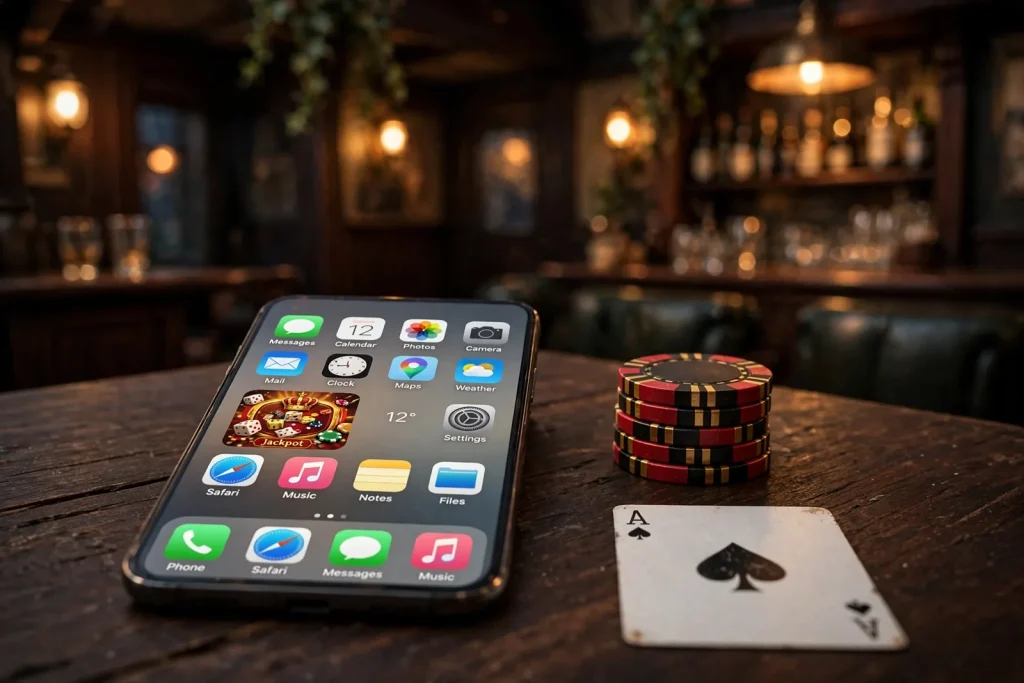
See what an installed app changes, what browser access avoids, and which licence, bonus and payment details are worth checking.
What's inside this guide
Casino Apps and the Mobile Browser Alternative
A casino app is a route into a mobile casino, not a prerequisite for using one. On a phone, the same operator may be available through an installed app or through its website in a mobile browser. That distinction matters because an app can make the service feel more like a regular part of the phone, while browser play avoids installing another piece of software.
The practical addition is access. An app puts an icon on the home screen, so returning to the casino can be a matter of opening that icon rather than finding a saved web page or entering an address. It can also keep the operator’s mobile service in one installed package. Those are modest conveniences, but they are the kind that shape a routine: the app is visible, familiar and easy to reopen.
There is a trade-off. Installing an app means making room for it and allowing it to remain on the device. A browser session needs no dedicated casino software; the operator’s site opens in the browser already used for other tasks. For someone who visits occasionally, that can be the simpler arrangement. For someone who prefers a persistent shortcut, an app may fit better.
The word “app” can sound like a separate or superior product. In practice, it describes a way of reaching the service, not proof that the games or account are different. The operator may present the same mobile casino through both routes. Whether the app adds anything useful depends on what it actually provides and on how the user prefers to access the site. An icon alone is not a reason to install it.
Browser play is a real alternative
Most casinos licensed by the UK Gambling Commission offer instant play through a mobile browser. That means a phone can be used without first downloading an app: open the casino’s website, sign in through its mobile pages, and use the service there. “Instant play” in this context describes access through the browser, rather than a requirement to install a separate application.
Trusted UK Casinos: What a Licence Really Means
That option changes the decision. App availability is often presented as a marker of a polished mobile service, but it is not the only way a casino can work on a phone. A browser route can be enough for someone who wants to make an occasional visit, does not want another app on the device, or simply prefers to keep activity in the browser. The important distinction is between having a mobile route and having an installed app; the two are not the same thing.
From an operator’s side, offering both routes can serve different habits. Some customers want a clearly labelled icon and a dedicated entry point. Others expect a website to adapt to the screen and do not want to install anything. An app can therefore be part of the operator’s presentation, but its presence does not establish that browser access is unavailable or that the app contains a different casino.
UK online casino payout rates, explained
When comparing mobile casino apps, I would separate the convenience of installation from the substance of the service. Does the app make access easier for the way the phone is used? Is the browser alternative readily available? Is the operator presenting the app as an extra route, or implying that it is essential? These are more useful questions than treating the word “app” as a quality rating. No download required.
It is also worth keeping expectations proportionate. An app does not automatically make every part of a casino more suitable for mobile use, and a browser does not automatically make it awkward. The operator’s mobile pages and the person’s own habits determine much of the experience. The available format alone cannot settle that comparison.
For UK casino apps, the sensible starting point is therefore not “Which operator has an app?” but “Which access route suits the way the service will be used?” Someone who returns often may value the home-screen shortcut. Someone who wants to avoid installing casino software may be content with browser play. Both routes can lead to a mobile casino, and neither preference needs to be treated as the correct one.
An app is an access choice, not a requirement for playing on a phone, as most UKGC-licensed casinos offer a browser-based "instant play" alternative.
That is the useful baseline behind claims about the best casino apps in the UK: an app is an access choice, not a requirement for playing on a phone. The browser alternative is already offered by most UKGC-licensed casinos, so the absence of an installation does not, by itself, mean the mobile service cannot be used.
Our top casino picks for the UK
- BeOnBetBonus: 100% up to €500 + 100 FS · Payout speed: 1-3 business days
- WinBeastBonus: €5000 + 500 FS + €650 Freebet · Payout speed: 1-3 business days
- NightWinBonus: £900 + 400 free spins · Payout speed: 1-3 business days
- JetsetspinsBonus: 200% Bonus + 100 Free Spins + Free Royal Wheel · Payout speed: 1-3 business days
- DieselwinBonus: Welcome Pack 250% up to £4000 + 200 FS · Payout speed: 1-3 business days
- EvoSpinBonus: 125% up to €2500 + 125 Free Spins · Payout speed: 1-3 business days
- SpinFormulaBonus: 550% Up To £15,000 + 550 FS · Payout speed: 1-3 business days
- Revery PlayBonus: 100% up to€1,000+ 100 FS · Payout speed: 1-3 business days
Native App or WebView: What the Difference Feels Like
The practical distinction between a native wrapper and a WebView is easiest to describe at the point of interaction. A native wrapper is an installed app that presents the casino’s mobile service through an app interface. A WebView embed displays web-based content inside that app. To a player, both may look like a casino mobile app; the difference becomes more apparent in how promptly a control responds.
A specialist review reported a sharp contrast at the spin button: in a native wrapper, the button responded in the same millisecond it was touched, while a WebView embed had a noticeable half-second delay. That is a reported comparison, not a guarantee about every app or device. Still, it captures the kind of distinction that can affect the feel of a session: the visible control may be in the same place, but the pause before it reacts is different.
That pause is not the same as the time a game takes to complete an action. It describes the reported response between touching the button and seeing it react. The distinction matters because a control that appears to hesitate can make the whole experience feel less direct, even when the screen and game content appear similar. It does not, by itself, establish anything about the quality of the game or the reliability of the account.
Casino Guides for UK Players: Licences and Access
I would treat the comparison as a narrow observation rather than a verdict on an online casino app. One reported response time cannot establish how every native wrapper behaves, or whether every WebView embed has the same delay. The result may depend on the particular implementation and the conditions under which it was observed. The useful point is more modest: the way an app packages and displays its service can be felt in small interactions, not just seen in its menus.
What the labels describe
“Native” can sound like a promise of a wholly separate casino product. In this context, the important distinction is the interface layer: a native wrapper is built to run as an installed app, while a WebView presents web content within an app shell. The label does not tell the whole story about what a player will experience, and it should not be treated as a broad quality rating.
A WebView is not automatically a poor experience. The reported half-second pause identifies one point of friction, not a complete assessment. Nor does an immediate button response prove that the rest of the app will feel better. Navigation, loading, layout and other interactions are separate questions, and the reported comparison does not measure them. I keep the judgement tied to what was actually described: the spin control’s response.
Do
- Notice if the interface gives immediate feedback when a control is touched
- Treat response time as a narrow observation of a specific app
Don’t
- Use a single fast-feeling control to decide which app is best overall
- Convert one observed experience into a market-wide technical rule
The same restraint applies to the phrase “best mobile casino app”. A fast-feeling control may matter to someone who notices every pause, but that single feature cannot settle which app is best overall. It says nothing by itself about the range of games, account tools, payment options or operator standards. Those are different considerations, not hidden consequences of whether a screen uses a wrapper or a WebView.
A small delay, clearly framed
A half-second can be noticeable because the control has already been touched and the expected feedback has not yet appeared. The player is left waiting for confirmation that the action registered. In a repeated interaction, that gap can make the interface feel less immediate. The reported native response, by contrast, was described as occurring at the millisecond of contact. Those figures convey the observed contrast; they should not be read as measured results for every casino mobile app.
This is why I avoid turning the distinction into a sweeping technical claim. The observation does not establish what causes the delay, and it does not show that every WebView is slower under all conditions. It only reports what the reviewer noticed in a particular comparison. A sound description preserves that boundary instead of converting one experience into a market-wide rule.
There is also a difference between responsiveness and speed in the wider sense. A button can acknowledge a touch promptly while the next screen or game action takes longer. Conversely, a short pause at one control does not mean every part of an app is slow. Keeping those ideas separate makes the comparison useful without loading it with claims it cannot support.
Foreign casinos for UK players: licensing and risks
For anyone comparing an online casino app with another, this is a practical detail to notice: whether the interface gives clear, immediate feedback when a control is touched. It is not a complete test, and it does not establish a winner. It is simply one of the few differences between a native wrapper and a WebView that can be described in direct, user-facing terms.
Small distinction. Visible effect.
Real-Money Play Depends on the Licence Behind the App
A real-money casino app is not made trustworthy by its icon, polished screens or presence in an app store. The important question is which rules apply when money is at stake. For customers in Great Britain, operators offering real-money gambling must hold the relevant UK Gambling Commission licence. That licence is the strongest consumer protection in the market; it places the operator inside a regulatory system rather than leaving the relationship to the app’s own promises.
I separate the software from the business behind it. An app is a route into an account. It does not, by itself, establish who is responsible for that account or what standards govern the operator. A casino real-money app can look much like another one, but the licence is what connects the service to enforceable obligations. Without that distinction, a familiar design can create a false sense of security.
A polished app design can create a false sense of security; only a UK Gambling Commission licence connects the service to enforceable consumer protections.
“Safe” is often used as if it described a product feature. It does not. In practice, the meaningful protection comes from the operator’s regulatory status and the controls attached to the account. A licensed service must offer deposit limits, and those limits can be set for daily, weekly or monthly periods in account settings. The control belongs to the account, not to the phone itself, so installing or opening an app does not replace the need to understand how the account’s limits work.
There is a reason this matters before play begins. A deposit limit is a boundary on money going into the account, not a promise about outcomes or a prediction of how long funds will last. Setting one gives the account a defined ceiling for deposits over the chosen period. The practical value lies in having that control available and being able to use it deliberately, rather than relying on a moment-by-moment decision while gambling.
UK rules also require operators to prompt new customers to set a financial limit before their first deposit and provide accessible account-level controls. That makes the limit part of the account-opening process, not merely a setting hidden away for later. For anyone comparing real-money casino apps, this is a more useful distinction than visual claims about a “premium” or “responsible” experience. The wording on a screen can be reassuring; the actual account control is what matters.
Offshore Casino Sites in the UK: Licensing and Risks
I have seen how product language can soften a firm condition. “Flexible” may mean the player can choose a daily, weekly or monthly limit, but it does not mean the operator can treat the control as optional. The UKGC requirement is that licensed operators offer deposit limits. A responsible setup should make the control accessible in account settings, with the chosen period and amount clear enough to understand before money is deposited.
That does not mean a licence removes every risk involved in gambling. It does mean the operator is subject to the UK regulatory framework, and that is a substantial difference from relying on a company’s own assurances. The licence is not a badge that tells anyone whether a particular session will go well. It is the foundation for consumer protections and account rules that apply to the service.
When I assess what makes a best real-money casino app, I put the licence and account controls ahead of decoration. That is not a ranking of particular apps; it is a way to separate regulatory substance from interface polish. A well-designed app may make controls easier to find, but the design cannot substitute for the operator’s obligations. Conversely, a plain interface does not tell the whole story either. The useful question is whether real-money play is offered by a UK-licensed operator and whether the account provides the required deposit-limit controls.
This point applies regardless of whether the app is described as being for Android, iOS or another device. The device does not change the core issue: real-money gambling is governed by the operator’s licence, while deposit limits are account controls. App features can vary, but the regulatory basis should not be confused with the presentation on screen.
Setting Deposit Limits
Access account settings
Locate the account settings within the licensed operator’s service.
Choose a period
Select whether the limit should be applied on a daily, weekly, or monthly basis.
Set the amount
Define the financial ceiling for deposits over the chosen period to establish a boundary on money going into the account.
We disclose that Ecopayz Casino UK may receive payment if a reader clicks an affiliate link and deposits with an operator. That commercial relationship does not change the standard used here: a recommendation should not imply that an app itself guarantees protection. Licence first. Account controls next.
Mobile Slots, Spin Speed and Autoplay Rules
A slot game on a phone still follows the rules for online slots in Britain. The smaller screen changes how the controls are arranged, not what the game is allowed to do. That matters when comparing a slot app with a desktop version: a compact layout is not permission for faster spins or automated play.
Autoplay is banned for online slots in Britain. The player has to start each spin rather than set a sequence running unattended. In practice, that keeps the decision to continue with the player, rather than letting a game cycle through repeated stakes while attention has moved elsewhere. A large spin button can make repeated play feel effortless; it does not remove that boundary.
There is also a minimum duration for each online slot spin: it must last at least 2.5 seconds. The rule applies whether the game is opened on a phone or another device. A quick tap can begin a spin, but the next one cannot be started before the required interval has elapsed. The interface may make that pause more noticeable on a small screen, where the result and controls share limited space. No shortcut.
Phone-credit deposits at UK mobile casinos: explained
Stake limits apply as well. For customers aged 25 and over, the maximum stake per online slot game cycle is £5. For customers aged 18 to 24, it is £2. The £5 limit for all adults took effect on 9 April 2025; the lower limit remains for the younger age group. These are limits on a game cycle, not a promise about how much a session will cost. Repeated permitted stakes can still add up, and the phone does not make that arithmetic less real.
I find it useful to separate a game’s presentation from its underlying play. Bright animations, a prominent button or a narrow vertical layout may make a slot feel different from its desktop counterpart. But those are interface choices. The restrictions on autoplay, spin duration and stake size govern the play itself, regardless of whether the game is labelled a mobile slot or appears inside a casino app.
That is why “best” is not a technical category. A slot app may make games easier to reach, but the label says nothing by itself about the pace of play or the controls available. The practical check is whether the game requires a separate player action for each spin and respects the required interval and stake limits. These safeguards are part of the regulated UK market, not optional settings a mobile operator can switch off to make play feel quicker.
For anyone comparing mobile slots, the rules are a more reliable starting point than claims about speed. A phone can place the next spin close to a thumb; it cannot lawfully turn that into autoplay or remove the minimum spin time. The distinction is simple. Convenience is not a rule change.
UK Slot Rules
Online slots in Britain prohibit autoplay, require a minimum spin duration of 2.5 seconds, and limit stakes to £5 (or £2 for those aged 18-24).
A Named Slot Example, Not a Catalogue of Games
A casino app can be judged by more than the number of titles shown in its menu. The useful question is whether a particular game was released for mobile as well as desktop, and whether its name is easy to identify across those formats. Big Bass Bonanza Megaways offers a concrete example: its desktop and mobile versions launched on 18 November 2023.
That date establishes that the game was made for both settings. It does not establish that every casino app includes it, or that a particular operator’s current catalogue has it available. Those are separate checks. A title can have a mobile version without being listed by every casino, so a game’s release history and an app’s present selection should not be treated as the same thing.
I find that distinction useful when comparing casino games on a phone. A long catalogue may look persuasive, but it says little about whether a specific title has a mobile release. Conversely, seeing a familiar game’s name in an app does not, on its own, explain whether the mobile version was launched alongside a desktop version or adapted later. The release detail gives a firmer point of reference than promotional labels such as “mobile ready”.
Big Bass Bonanza Megaways is a single example, not a ranking or a recommendation. Its relevance here is format availability: the game was released in desktop and mobile versions on the same stated date. That makes it a practical illustration of how one slot can be intended for more than one screen environment, without turning the discussion into a catalogue of casino app games.
Offshore casinos for UK players: legal checks
When checking a particular casino game app, the title itself is the starting point. Search the operator’s game list for the exact name, then confirm that the listed game is the one being discussed. A shared or similar title is not enough to establish that it is the same release. The distinction matters because app menus are built around what that operator makes available, while a game’s launch information describes the game’s formats.
So this example answers a narrow question well: Big Bass Bonanza Megaways had desktop and mobile versions from launch. It cannot stand in for every slot games app, nor does one release date prove what a casino currently offers. One title. Two formats.
Free Spins and the Conditions Behind a Bonus
Free spins look like a simple addition to a casino app balance, but the headline number says little about what can be withdrawn. The terms attached to the promotion decide whether winnings remain available, how much play is required first and when the offer expires. I treat the free-spin count as the opening detail, not the measure of value.
A key condition is the wagering requirement. A specialist review describes a common range as 35x to 40x the bonus amount. That calculation applies to the bonus, not necessarily to the winnings from the spins, so the wording matters. If the offer grants a bonus alongside free spins, its terms should make clear which part has to be wagered and whether spin winnings are added to that balance. The total play required can be substantial even when the bonus itself looks modest.
Common Bonus Restrictions
- Wagering Requirements: Often range from 35x to 40x the bonus amount.
- Maximum Cashout: Caps are frequently reported between £100 and £200.
- Time Limits: Wagering windows typically last 7 to 14 days, though some are as short as 72 hours.
The next restriction is the maximum cashout. A specialist review reports caps of £100 to £200 on many bonuses. If winnings pass the stated cap, the excess may not be withdrawable under the promotion. That changes the practical value of a large run of winning spins: the displayed balance and the amount eligible for withdrawal are not always the same thing. “Free” is the sales word. The cap is the accounting.
Time limits matter too. A specialist review places common wagering windows at 7 to 14 days, while some offers allow only 72 hours. The clock can start when the bonus is accepted, rather than when the spins are used, so a player who leaves the promotion untouched may still lose time. A short expiry can make an otherwise attractive reward difficult to complete, especially when the wagering requirement is high.
I have seen promotional copy put the spin count first and the restrictions deep in the terms. That ordering is deliberate: the benefit is immediately legible, while the cost takes calculation. Before accepting, the useful comparison is between the wagering multiple, the time allowed and the maximum cashout. Each condition limits a different part of the outcome.
Non-UK-Registered Casinos: Licensing Explained
A free casino app or a casino app with free spins is not more valuable simply because the offer is visible on a phone. The same terms determine what happens after acceptance, whether the spins are used in an app or elsewhere. If the cap, expiry or wagering calculation is unclear, the headline reward cannot settle the question. Read the mechanics first. Then the promotion.
Android Casino Apps: What Can Be Verified
An Android label on a casino page is not, by itself, proof that a particular app will work on every Android phone. Compatibility can depend on the device and its software, and those details need to come from the operator’s current information. I would not rank an app as the best Android option without a clear basis for that claim.
The useful distinction is between a general promise of mobile access and confirmed support for a specific app and device. An operator may describe its service as mobile-friendly without establishing that a downloadable Android app is available, or that it supports a particular handset. Those are separate claims. The wording matters.
Before treating a casino app for Android as a practical option, look for the operator’s own current app information. Where an app listing is provided, its compatibility details should be checked alongside the operator’s support pages. If the available information does not identify supported devices or software, that uncertainty remains; a broad “Android compatible” label does not fill in the detail.
Android App Verification
- Check the operator’s current app information for confirmed Android support
- Verify the device and software requirements against your own handset
- Use the operator’s support route if compatibility details are unclear
I also separate availability from quality. A listing or download route can establish that an app is offered, but it does not, on its own, show how well it will behave on a given phone. Claims about the best app for slots or the best casino app for playing on the go need evidence tied to actual compatibility and use, not just a prominent badge or a polished description. I would not turn a general mobile claim into a tested recommendation.
The same caution applies when comparing Android with iPhone. A casino may support both platforms, but that does not establish identical app availability or performance across them. The relevant details are the operator’s current platform-specific instructions, not the fact that another version exists.
For UK players, “best” is therefore not a reliable conclusion unless the specific operator and Android support can be checked. The practical test is modest: confirm that the operator describes an Android app, check the stated requirements against the device, and use the operator’s support route if those details are unclear. If no device requirements are published, treat compatibility as unconfirmed rather than assuming it.
No guesswork.
Checking a UK Casino App Before Opening an Account
A casino app is only one route into an operator’s service. The legal check belongs to the company running the gambling, not to the app’s appearance, download page or name. In the UK, online casinos are legal when they are licensed and regulated; remote operators serving Great Britain must hold the relevant UK Gambling Commission licence.
International casinos for UK players: licensing and risks
I start on the operator’s homepage, rather than relying on a badge or a claim inside the app. The UKGC licence number should be shown at the bottom of the homepage. That gives a specific detail to look for, instead of leaving the check at the level of a logo or the general phrase “fully licensed”. Those words sound reassuring. The number is the useful part.
The distinction matters when a brand has several digital touchpoints. An app may present the games and account functions, while the homepage identifies the operator behind them. The operator’s identity and its UK licence status are the relevant points for a UK casino app. A polished interface, familiar game imagery or a prominent download button does not, by itself, establish that the service is authorised for UK real-money play.
I also keep the check separate from comparisons of sign-up offers or app features. Promotional wording can draw attention away from the basic question of who is offering the gambling and whether that operator holds a UK licence. Any offer is secondary to that identification. The same applies to a slot machine app or a casino betting app: the label used for the product does not change the licensing requirement for the operator providing real-money gambling.
This is a small check, but it sets the right order. Identify the operator on its homepage, locate the UKGC licence number at the bottom, and assess the service in the context of UK licensing rules. The licence is not an app feature. It is the regulatory basis for offering online casino play to customers in the market. A number, not a slogan.
Verifying UK Apps
- Identify the operator via the official homepage
- Locate the UKGC licence number at the bottom of the page
- Prioritize the regulatory licence over interface polish or promotional claims
Live Dealer Games on a Phone: Browser Access and Limits
A live dealer game does not automatically require a dedicated casino app. Most UKGC-licensed casinos allow instant play through a mobile browser, so a phone can provide a route into the casino without installing software. Whether a particular operator makes its live dealer games available through that route is a separate question: mobile access to the casino does not, by itself, confirm that every game is included.
That distinction is easy to miss in app descriptions. “Full casino” may describe the operator’s wider catalogue, rather than guaranteeing that every table game appears in every mobile format. I treat access as a game-by-game detail, not a promise implied by the word “app”. The operator’s own mobile lobby is the useful place to establish what is available.
There is also a limit to what the label “live dealer casino app” tells anyone. It identifies a way of reaching an operator, not a measurable standard for the live tables. Without details about the specific casino and game, claims that one app is the fastest or best for live play are not a sound basis for comparison. A browser route may be enough; an app is not proof of a better live-dealer experience.
For mobile slots, the same browser option may be relevant, but slots and live tables are different parts of the catalogue. Access to one does not establish access to the other. The practical check is whether the desired live game is listed in the casino’s mobile lobby and can be opened from the phone’s browser or app.
I would separate three questions: can the casino open on a phone, does it offer live dealer games, and are those games available in the mobile format being used? Most UKGC-licensed casinos answer the first through instant browser play. The other two depend on the operator’s actual catalogue and presentation. No shortcut around that.
Casino Sites Not on GamStop UK: What It Means
iOS, Bingo and Paying from a Mobile Device
On an iPhone or iPad, the useful question is not whether an app calls itself a casino or bingo app, but which deposit methods appear in its cashier. The label does not determine how a payment is processed. Apple Pay and debit cards are the relevant options when they are offered, and the same basic payment mechanics apply whether the account is used for casino games or bingo.
In a specialist review of tested apps, Apple Pay deposits were recorded as instant and completed in two taps. That is a report about the apps checked, not a promise that every iOS app will show Apple Pay or process every transaction identically. The cashier is the place to confirm whether it is available before relying on it.
Specialist payment reviews describe debit-card deposits as generally arriving instantly, although a bank may flag a gambling transaction. A delay or decline can therefore come from the card issuer rather than the casino’s app. I would treat the payment confirmation as the useful checkpoint, rather than assuming that tapping the deposit button means the funds have cleared.
Online casino no registration in the UK: checks explained
Minimum deposits vary between apps. Reviews of casino apps report £5 as a common starting point, while some accept £2. Those amounts are not a guarantee for a particular account: the minimum shown in the cashier is the operative one, and it may differ by payment method.
A “no deposit” offer is a promotional description, not a way to pay. It should not be confused with a deposit method or taken to mean that an app has no cashier conditions. Any deposit still needs to be made through a method the operator accepts.
The practical comparison is modest: Apple Pay can reduce the steps at checkout, while a debit card may be subject to a bank’s checks. Neither method makes a bingo-branded app inherently better for funding. We may earn a commission if a reader clicks a link and deposits.
How long should a mobile casino withdrawal take in 2026?
For UK-licensed casinos, e-wallet withdrawals should realistically arrive within 24 hours. Bank transfers typically take 3–5 business days, while debit card withdrawals take 1–3 business days.
How does the ADR scheme work for payout disputes?
UK-licensed casinos must belong to an approved alternative dispute resolution provider. If the casino does not resolve a legitimate payout complaint through its internal process, you can take the dispute to that ADR body.
Which bonus terms most commonly block withdrawals?
Wagering requirements, maximum bet limits, game weighting and maximum cashout caps can all restrict bonus withdrawals. Check these terms before accepting an offer.
What does wagering on a welcome offer actually mean?
It means placing bets until you meet the offer’s required turnover, commonly 35x to 40x the bonus amount. The offer may also set a deadline, a maximum bet and a cap on winnings.
How fast are withdrawals on these apps?
The fastest observed e-wallet withdrawal was 2 hours via PayPal; the realistic benchmark for UK-licensed operators is under 24 hours for e-wallets. Bank transfers typically take 3–5 business days and debit card withdrawals 1–3 business days.
Are there any fees for using phone credit?
Some mobile networks add a premium-rate fee of around £0.50 to £1.50 for pay-by-phone deposits. The charge is added to your next phone bill or deducted from your pay-as-you-go credit.
Casino Guides
Created by the "Ecopayz Casino UK" editorial team.