
ecoPayz vs Skrill vs Neteller: UK Casino Payment Comparison
 Available in GB
E-Wallet Showdown: Evaluating Real Transaction Limits
I’ve spent the better part of eight years reading e-wallet fee schedules at the kind of weekly cadence most people reserve for the weather forecast. The thing that still surprises me is how often British players pick between Payz, Skrill and Neteller on the assumption that the three are interchangeable. They are not. They differ on ownership, on tier ladders, on per-currency FX margin, on which casinos will even show them in the cashier, and on which ones quietly disqualify your welcome offer at the first deposit.
What's inside this guide
This matters more in 2026 than it did even two years ago. Mobile wallet penetration in the UK jumped from 42 per cent of adults to 57 per cent inside a single year, and 71 per cent of all online wagers in the country now move through a phone rather than a desktop. The cashier you tap on a Saturday night is making a real decision on your behalf, and the e-wallet sitting behind that button decides how much of your deposit actually lands in the casino balance.
So I’m going to do what the comparison pages don’t: walk through the three providers in parallel, parameter by parameter, with the same yardstick applied to each. Where Payz wins, I’ll show why. Where Skrill or Neteller wins, I’ll say so plainly. No favourites, no rankings dressed up as analysis.
If you are exploring alternative e-wallets, our detailed comparison of ecoPayz vs PayPal at UK casinos highlights the key differences in fees and bonus eligibility.
Who actually owns Payz, Skrill and Neteller
The first thing players miss is that two of these three e-wallets share a corporate parent. Skrill and Neteller both sit inside Paysafe Group, a Canadian-listed payments holding company. They are run as separate brands with separate apps and separate user balances, but the underlying compliance stack, the merchant integrations and the treasury function all share infrastructure. Payz, by contrast, is operated by PSI-Pay Ltd — a privately held UK firm with FCA registration number 900011 and Principal Member status with Mastercard since 2009. That Principal Member designation is rarer than it sounds; most e-money issuers ride on someone else’s BIN, but PSI-Pay can issue prepaid and debit cards in its own right across 173 countries and 44 currencies.
Where Payz looks small on paper is the market-share figure. PSI-Pay’s 2024 accounts show total assets of £64.97 million, net income of £260,634, and roughly 0.16 per cent of the UK e-money market — 58th place among domestic EMIs. That’s nothing compared to the consumer-fintech giants. But it puts Payz in a different category from Skrill and Neteller, which through Paysafe Group sit much higher up the rankings.

The practical takeaway is that when British casinos do their payments due diligence, they assess Payz on its own balance sheet and on PSI-Pay’s regulatory record. They assess Skrill and Neteller on Paysafe Group’s. That distinction shapes which operators integrate which wallet, and how quickly compliance teams clear new merchant onboardings — a point I’ll come back to in the casino-acceptance section. PSI-Pay’s CEO Andy Downes summed up the company’s specialism in a corporate statement on the Payz partnership: “We developed a bespoke solution shaped around Payz and their needs, covering all of the required functionality.” That’s analyst-speak for a tightly scoped, gambling-friendly mandate rather than a generic consumer-payments product.
Where the fee gap is actually hiding
Fees are the lazy headline of every e-wallet review, and they’re almost always quoted wrong. The right way to think about it is in three layers: the FX layer, the per-transaction layer, and the inactivity layer. Each provider charges differently in each of those layers, and the layer that hurts most depends on how you actually use the wallet.
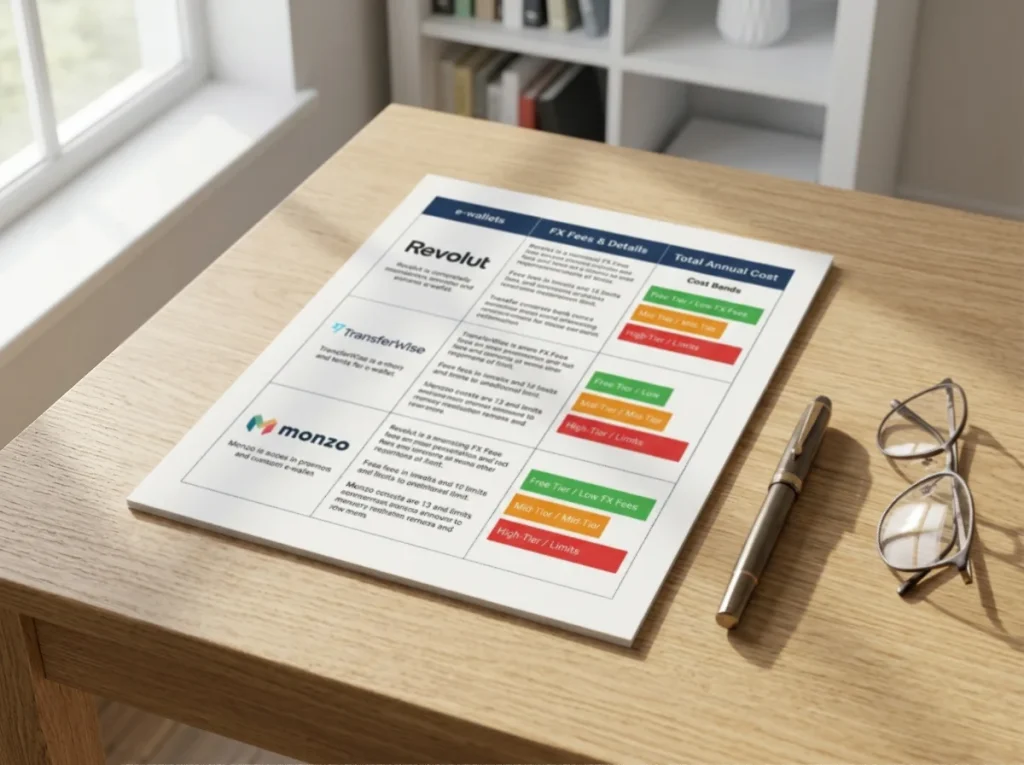
Start with FX, which is where Payz wins the cleanest comparison. The Classic tier — the one you get the moment you finish basic verification — charges 2.99 per cent on cross-currency conversion. Gold drops that to 1.49 per cent. Platinum and True VIP go down to 1.25 per cent. Skrill and Neteller, by contrast, both apply 3.99 per cent on currency conversion at their entry tiers. For a British player who keeps a GBP wallet and deposits at a GBP casino, FX never triggers and the headline gap is irrelevant. For a player whose wallet sits in EUR — common among people who started using these wallets while travelling or before the credit-card ban shut off easier funding — that one-point gap eats real money on every deposit.
The per-transaction layer is where the picture gets noisier. Casino deposits from any of the three e-wallets are typically free on the wallet side; the casino pays the merchant fee, not you. Withdrawals are different. Skrill and Neteller historically charged a flat percentage on outgoing transfers to bank, with a minimum that punishes small cashouts. Payz applies a fixed sterling amount on the withdrawal-to-bank route, scaling down at higher tiers. The Mastercard cash-out route, available on all three (Payz, Skrill and Neteller all issue branded cards), brings its own card-scheme costs — and that’s before the £100 contactless cap, the £750-equivalent daily ATM limit and the €5,500-equivalent daily purchase ceiling on the Payz Mastercard come into play.
Inactivity is the layer nobody reads. All three providers can charge dormancy fees if your account sits idle for long enough — typically a year, sometimes shorter on lower tiers. For a casual player who funds a casino account every six months and then leaves the wallet alone, the inactivity fee can outweigh anything you saved on FX. I’ve sketched out the per-tier numbers in a dedicated fees breakdown for anyone who wants the tier-by-tier ledger.
If you take only one number from this section, take this one: Payz’s 2.99 per cent Classic FX rate sits a clean point below Skrill and Neteller’s 3.99 per cent. Over a year of weekly cross-currency deposits, that’s the difference between a couple of pints’ worth of margin and a hundred pounds.
What the deposit feels like, step by step
The deposit flow is the one moment in your relationship with an e-wallet where speed and friction become tangible. I run test deposits in all three wallets roughly every quarter — small amounts, just to monitor changes — and the experience has converged over the last two years even as the back-ends have stayed different.
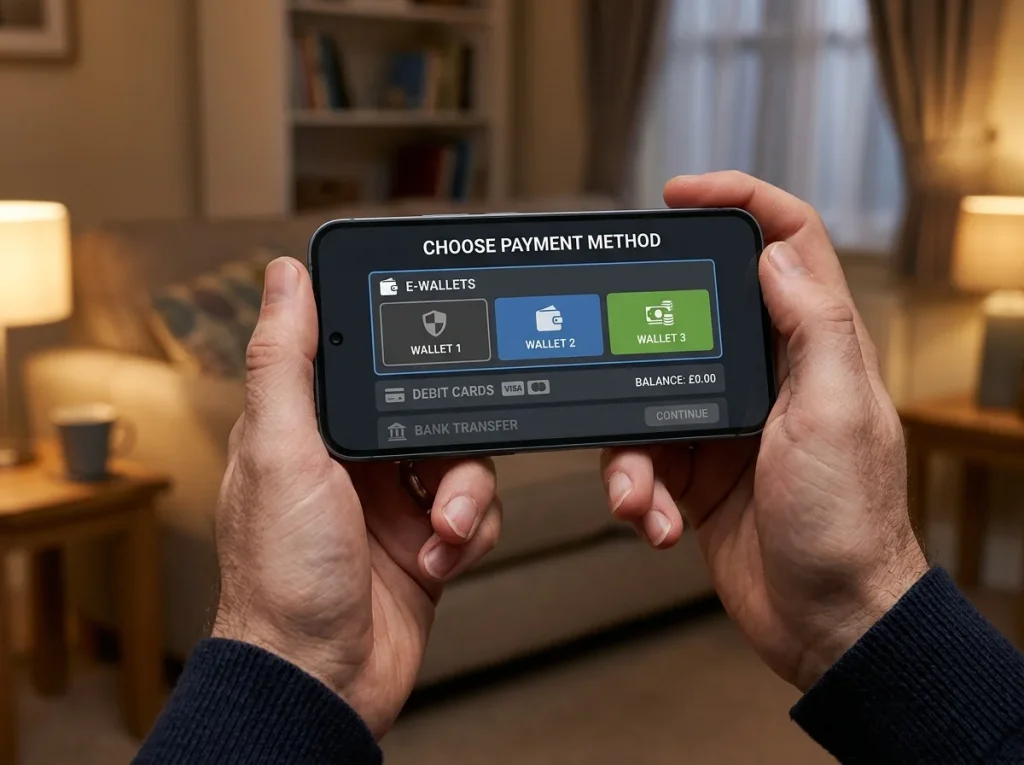
The pattern is now broadly identical on Payz, Skrill and Neteller. You pick the wallet in the casino cashier, you’re bounced to the provider’s hosted authentication page or you confirm inside the wallet app, you complete a 2FA step (push notification, authenticator code or SMS depending on what you’ve set up), and the casino balance updates in seconds. With 80 per cent of online gamblers now treating a smartphone as their primary device, the deposit flow is designed around fingers and faces, not card numbers and CVV codes.
Where the three diverge is in the edge cases. Payz’s app handles the redirect smoothly when you’re on the same handset where the wallet is installed; if you’re on desktop, you scan a QR. Skrill and Neteller, sharing the Paysafe back-end, route through an almost identical confirmation screen — which is convenient if you have both, less so if you’ve forgotten which login you used. Neteller’s redirect occasionally still asks for a SecureID code from a physical token if you’ve enabled hardware 2FA, a holdover that some long-time gamblers find reassuring and newer ones find baffling.
One detail British players underestimate: deposit limits the casino sets, separate from the wallet’s own limits. The UK Gambling Commission requires operators to offer deposit limits at multiple intervals; the wallet doesn’t know or care what limits you set on the casino side. If your Payz Classic tier allows up to £2,500 a day on the wallet and your casino has you capped at £200, the £200 wins. The deposit will reject silently at the casino layer rather than the wallet layer, and the error message rarely tells you which side blocked it.
For day-to-day depositing, none of the three feels meaningfully faster than the others. The differences live in the second and third deposit of the day, when AML thresholds and casino-side velocity checks start firing — a layer I unpack later under safety and compliance considerations.
What the cashout actually does to the clock
Withdrawal speed is where players judge an e-wallet most harshly, and where the three providers are most often misrepresented. The honest answer is that withdrawal speed is mostly a function of the casino, not the wallet. Once a casino has approved a payout, the e-wallet leg of the journey is typically minutes, sometimes seconds. The hours and days that frustrate players sit upstream, in casino-side review queues and KYC re-verification.
That said, the three providers do differ in a couple of measurable ways. Payz’s e-money infrastructure, built around the PSI-Pay framework, supports €3 billion in global transactions through what the company calls a bespoke partnership build, with liquidity sitting on a tightly held balance sheet. The 2024 net income of £260,634 looks unimpressive, but the same accounts show liquid assets sufficient to clear normal-volume settlements without delay. Skrill and Neteller, riding Paysafe’s larger treasury, handle higher absolute volumes and can absorb spikes more gracefully — useful when a big slot win clears at peak time.

In the UK specifically, the volume context matters: online gambling generated £1.42 billion in gross gambling yield in Q2 FY 2025-26 alone, up 8 per cent year on year. That’s the river of payouts the three e-wallets sit on the receiving end of. None of them is the bottleneck. The bottleneck is casino-side AML review, which has tightened materially after the enforcement actions of late 2025.
Where the wallets do influence the clock is in the route from wallet to your bank. Payz to UK bank account via SEPA-style transfer typically clears one to three business days, with the Gold tier and above getting prioritised processing. Skrill’s bank-transfer leg behaves similarly. Neteller’s, in my testing, tends to land in the same window. The Mastercard cash-out route — funding a card and then ATM-withdrawing or spending — is the closest any of the three gets to instant, with the trade-off of card-scheme fees and the daily ATM and purchase caps.
If raw speed to spendable cash is your priority, the Mastercard route on any of the three providers beats the bank-transfer route. If preserving the headline withdrawal value matters more, the bank-transfer route saves you scheme fees but costs you a day or two.
Where bonuses get blocked and why
Welcome bonuses are the trapdoor of e-wallet gambling. Almost every UK casino’s bonus terms now contain a clause excluding deposits made via e-wallets from the bonus calculation. This isn’t a Payz problem, a Skrill problem or a Neteller problem in isolation — it’s a casino-side response to the way e-wallets historically enabled bonus abuse, where players cycled deposits through wallets to claim multiple welcome packages.
The exclusion lists vary. Some operators block all three e-wallets uniformly. Others block Skrill and Neteller specifically, because Paysafe’s wallets came up most often in the abuse patterns operators submitted to bonus-mitigation services. A smaller subset blocks Payz. The closest thing to a pattern I’ve found, looking at terms across UKGC operators that generate the bulk of the £5.0 billion annual online GGY, is that the bigger and older the operator, the more uniformly all three are excluded. Newer operators, hungry for deposits, are more likely to allow at least one of the wallets to qualify.
The mechanic to watch is wagering eligibility, not just the qualification step. Even when an e-wallet deposit triggers the bonus, some operators count e-wallet-funded wagers at a reduced contribution rate towards rollover. So you might “get” the bonus, only to find that £100 wagered on slots funded from a Payz deposit counts as £50 toward the wagering requirement.
Beyond welcome offers, the reload and loyalty bonus landscape is even less consistent. I’ve tested matched-deposit reloads on accounts funded exclusively through Payz and found that some operators accept them without issue, others apply the e-wallet exclusion, and a handful flag the account for manual review on the next withdrawal — which is its own form of penalty even if the bonus itself technically went through. The right move is to read each operator’s terms before depositing, not after.
None of the three e-wallets is “the bonus-friendly one” in any meaningful sense. The bonus question is a casino-by-casino question, and the wallet choice barely moves the needle.
How the tier ladders compare side by side
Tier systems are where Payz, Skrill and Neteller diverge most. The mechanics look superficially similar — verify more, spend more, get better rates — but the rate ladders and the verification gates are structured very differently.
Payz runs a five-rung ladder. Classic sits at 2.99 per cent FX with basic ID verification. Silver layers in additional KYC and the same 2.99 per cent. Gold steps the FX rate down to 1.49 per cent but requires a monthly fee — payable in fee-or-spend equivalent — and additional source-of-funds documentation. Platinum drops to 1.25 per cent at materially higher monthly volume. True VIP, the top rung, runs at 1.25 per cent with bespoke account management.

Skrill and Neteller, both inside Paysafe, run their own loyalty schemes with points earned through transaction volume rather than tier-locked fee rates. The headline FX rate stays at roughly 3.99 per cent across tiers, with reductions earned through cashback-style mechanisms rather than rate cuts at the cashier. That structural difference matters: Payz rewards you with a lower fee at the moment of transaction, whereas Skrill and Neteller reward you with points or rebates that arrive separately.
For a player who funds a casino weekly, the Payz tier ladder is cleaner to model. You know exactly what the next deposit will cost in FX terms because the tier-locked rate doesn’t move. Skrill’s and Neteller’s points-based schemes make the all-in cost harder to forecast because cashback realises on different timelines than the deposit it offsets.
The cost-benefit of climbing the Payz ladder is straightforward arithmetic: if your annual cross-currency conversion would generate more than the Gold tier’s monthly fee at the Classic rate, the upgrade pays for itself. If not, stay on Classic. Skrill and Neteller’s tiers don’t lend themselves to that clean calculation; you’d need to model expected cashback against expected volume, which is harder without operator-side data.
One nuance: Payz lets you hold sub-accounts in multiple currencies inside the same login. Skrill and Neteller offer multi-currency too, but the way the conversion fires differs. If you keep a GBP balance and deposit at a GBP casino, none of the three triggers FX. The moment you cross currencies, Payz’s lower headline rate becomes a real number.
Where each wallet shows up in the cashier
The UK Gambling Commission’s register lists 2,179 licensed gambling operators. Not all of them are casinos — sportsbooks, bingo and lottery operators are in the same number — but the licensed casino subset is substantial. The question of which of those operators accept which e-wallet is messier than the marketing pages suggest.

Skrill and Neteller’s footprint across UK-facing operators is the broadest of the three. Both have been embedded in the industry since the mid-2000s, both have direct integrations with the major casino-platform providers, and both appear in the cashier menus of nearly all the long-established operators. Payz, the smaller player by market share, holds third place among e-wallets in online gambling — behind Neteller and Skrill, but ahead of niche regional wallets — and is accepted at a meaningful subset of UKGC-licensed casinos, more concentrated among operators who target an international player base.
The pattern I see when auditing operator cashier menus is that Skrill and Neteller tend to appear together; if a casino accepts one, it usually accepts the other. Payz appears alongside them at operators with broader international reach, and sometimes alone at smaller operators where it filled the gap a competitor left behind. The newest UKGC-licensed casinos, launched after the late-2024 wave of platform consolidations, are roughly evenly split.
For a British player choosing a wallet purely on the basis of casino availability, Skrill or Neteller will get you into more cashiers without friction. For a player choosing on the basis of fee economics — especially anyone whose Payz balance sits in a non-GBP currency, or anyone planning to climb the tier ladder — Payz’s narrower acceptance footprint is mostly a non-issue because the casinos that take Payz tend to be the ones a regulated UK player would consider anyway.
Which provider fits which player profile
The honest answer to “which is best” depends entirely on how you use the wallet. Let me map the three providers to the player profiles I see most often.
For the high-frequency single-currency player — GBP wallet, GBP casino, weekly deposits, small reload bonuses — the three e-wallets are functionally equivalent on day-to-day economics. Acceptance breadth tips the balance toward Skrill or Neteller. The deciding factor is which one your preferred casino has on the cashier menu, and whether your existing wallet history (a long-standing Skrill account, for example) saves you a verification round.
For the cross-currency player — wallet in EUR, deposits at GBP casinos, or the reverse — Payz wins on FX economics by a clear margin. The 2.99 per cent Classic rate against Skrill and Neteller’s 3.99 per cent compounds across deposits in a way that becomes obvious after a quarter of activity. Cross-currency users should also look hard at the Gold tier, where the rate steps to 1.49 per cent.
For the volume player who can justify climbing the tier ladder, Payz again offers cleaner economics because its tier rewards are baked into the transaction rate rather than offered as separate cashback. The trade-off is the verification depth required at Gold and Platinum, which goes well beyond a passport scan into source-of-funds documentation.
For the casual player who funds a casino account once or twice a year, the wallet choice barely matters on economics. What matters is dormancy protection: don’t let the account sit idle long enough to incur inactivity fees, and pick whichever wallet you can keep modestly active without effort. All three charge inactivity penalties, and all three are equally annoying about it.
For the player worried about counterparty risk — what happens if a wallet provider runs into trouble — Skrill and Neteller’s Paysafe backing offers scale, while Payz’s PSI-Pay backing offers a tighter FCA-supervised perimeter under registration number 900011. Both regulatory frames are robust; the distinction matters mainly at the margins, in scenarios I cover in the safeguarding analysis elsewhere on this site.
Discover the most reliable payment methods and platforms on our top UK Payz casino guide.
Why is ecoPayz often cheaper than Skrill or Neteller at the same casino?
Because the difference shows up in FX, not in the headline deposit charge. Payz Classic charges 2.99 per cent on cross-currency conversion, while Skrill and Neteller both run at 3.99 per cent at entry tiers. For a single-currency player it"s invisible; for anyone whose wallet currency doesn"t match the casino"s, that one-point gap compounds with every deposit. Payz"s tier ladder also drops the FX rate further at Gold to 1.49 per cent and at Platinum to 1.25 per cent, whereas Skrill and Neteller reward volume through points and cashback rather than a lower transaction rate.
Do Skrill and Neteller really share the same back-end, and what does that mean for redundancy?
They share corporate ownership under Paysafe Group, and they share substantial parts of the compliance, treasury and merchant-integration stack. They are run as separate brands with separate user balances, but a serious operational incident on the Paysafe side would affect both simultaneously. Payz, operated by PSI-Pay Ltd under FCA registration 900011, sits on a separate infrastructure entirely. That"s not a reason to prefer one over the other in isolation, but it"s a relevant point for anyone who"d treat holding both Skrill and Neteller as meaningful diversification — it isn"t.
Which of the three is most likely to be accepted at a brand-new UKGC-licensed casino in 2026?
The pattern across newly licensed UK operators is roughly even, with a slight tilt toward Skrill and Neteller because their merchant integrations are pre-baked into the major casino-platform providers. Payz appears in the new-launch cohort more often than its overall market share would suggest, partly because PSI-Pay"s Principal Member status with Mastercard since 2009 makes the card-issuing leg of the integration straightforward. By the time a new operator has been live for six months, all three wallets typically appear in the cashier menu if the operator has international ambitions.
Can I hold all three wallets and pick the best one per deposit?
Yes, and a small minority of high-volume players do exactly that. The trade-off is verification overhead — each wallet runs its own KYC, each has its own dormancy policy, and managing balances across three providers introduces its own friction. For most British players a single wallet, chosen on the basis of FX economics for your currency situation and acceptance breadth at the casinos you actually use, is the more rational answer.
Recommend
Prepared by the Ecopayz Casino UK editorial staff.