
Casinos That Accept WebMoney UK: Payment Guide
 Available in GB
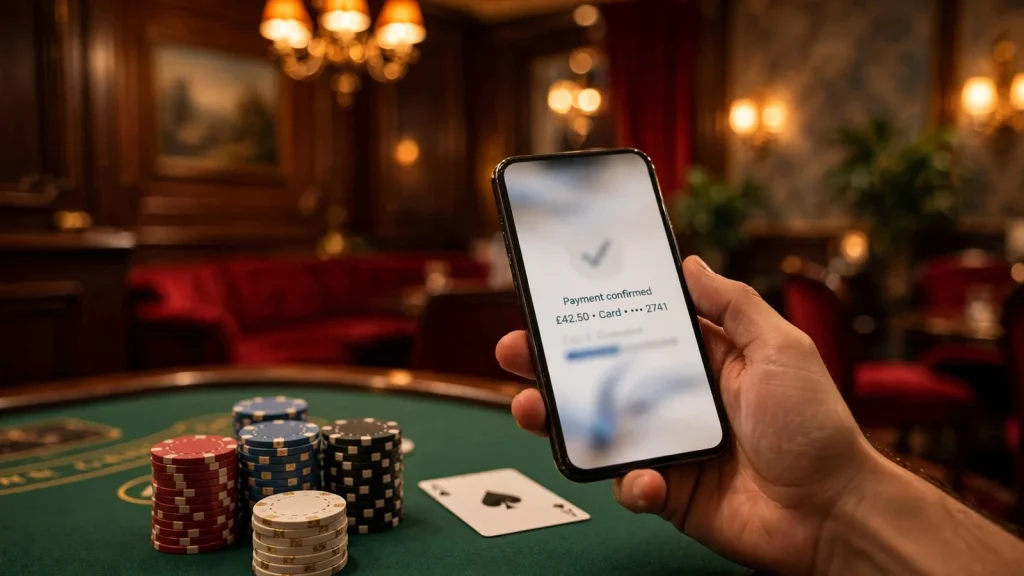
Boku may appear as a direct phone-bill deposit option, but it is not WebMoney and cannot be used to withdraw winnings.
What's inside this guide
The UK market has moved on from direct pay-by-phone deposits
A search for casinos that accept WebMoney can lead into a different payment-method story: Boku is a direct Pay by Phone option, while WebMoney is a separate service. A casino listing one does not establish that it accepts the other. The two names should not be treated as interchangeable, and a list of Boku casinos is not a WebMoney directory.
Boku has not disappeared from the UK casino market, but it is no longer a payment option that can be assumed to appear across operators. A small number of UK Gambling Commission-licensed casinos still accept Boku deposits. The available picture is of a shrinking group, rather than a method expanding into a broad range of new sites. A specialist review identifies Jackpot Mobile Casino and Peachy Games among the remaining direct-Boku options. That is a snapshot, not a permanent cashier guarantee: operators can change payment options, and the cashier is the practical point at which availability is confirmed.
From the operator’s side, payment methods are not simply permanent features of a brand. A cashier can be revised as commercial and compliance decisions change. Since 2023, accounts of the market have described operators moving away from Boku, with some replacing it with another Pay by Phone service and others removing phone-based payments altogether. A specialist review identifies Fonix and Siru Mobile among the replacements. This is a reported direction of travel, not a claim that every operator has made the same change.
That distinction matters when a casino is described as supporting mobile payments. The phrase can cover different services, and the name shown in the cashier may not be Boku. I would not read a general “Pay by Phone” label as proof of direct Boku acceptance. Nor does a casino’s continued operation mean that every payment option shown in an old review remains available. Payment pages age quickly; brand names tend to outlast the cashier details attached to them.
Casinos That Accept Wire Transfers in the UK
The same caution applies to lists presented as the best new WebMoney casinos or as all WebMoney casinos in the UK. Those labels can blur together three separate questions: whether a site is licensed for the British market, whether it currently accepts WebMoney, and whether it supports Boku. One answer does not settle the others. In particular, the remaining Boku names should not be recast as WebMoney sites without confirmation of WebMoney in the operator’s own cashier.
I regard a payment-method list as useful only when it names the exact service and makes clear what was checked. A broad reference to phone payments may be accurate in one sense while still failing to answer whether Boku is available. An older page may also preserve an operator’s former payment arrangement after the cashier has changed. The result is a familiar mismatch: the casino brand is current, but the payment detail is not.
There is also a regulatory boundary to keep in view. For remote gambling offered to consumers in Great Britain, operators must hold the relevant UK Gambling Commission licence, regardless of where their key equipment is located. A payment logo is not evidence of that licence. The operator’s regulatory status and its cashier options are separate checks, and neither should be inferred from the other.
So the practical state of the UK market is narrow: direct Boku remains at a small number of licensed casinos, while reported operator changes point towards replacement or removal rather than wider availability. That does not answer whether a particular casino takes WebMoney. It does explain why a list of phone-payment casinos, even a recent one, cannot stand in for a verified WebMoney list. Different services. Different checks.
Why casino cashiers offer Boku, Fonix or Siru instead
A casino cashier can show several ways to pay by phone, but those labels do not describe one interchangeable service. Boku, Fonix and Siru Mobile are separate payment options. A search for WebMoney does not establish that any of them will accept a WebMoney balance, or that a particular casino supports WebMoney at all. The relevant distinction is what the cashier actually lists and which service processes the payment.
Boku, Fonix and Siru Mobile are separate payment options; a casino offering a general "Pay by Phone" route does not necessarily support Boku specifically.
That matters because “Pay by Phone” is a category, not a provider name. A casino may offer a phone-based payment route without offering Boku. In the operator’s cashier, Fonix or Siru Mobile may appear where an older list, review or comparison refers to Boku. Treating every phone payment as Boku can lead to the wrong expectation about what is available at account level.
The named operators illustrate the difference. A specialist review identifies MrQ and Duelz with Fonix, and Mr Vegas and Videoslots with Siru Mobile. Those are specific provider-operator pairings, not evidence that the same options appear at every casino or remain unchanged indefinitely. Payment menus can change, so the cashier is the practical check before a deposit. The logo alone is not a guarantee of availability.
There is also a difference in the way a payment route is described. Boku charges a deposit to a mobile phone bill or deducts it from PAYG credit. Pay by Phone and Fonix are supported by EE, O2, Vodafone and Three; that does not make the services identical, nor does it mean every customer on those networks can use every casino’s payment option. The operator decides what its cashier supports, while the mobile payment service and network affect whether the route can be completed.
This is why names matter more than broad labels. When a cashier lists Boku, it is a direct Boku option. When it lists Fonix or Siru Mobile, it is offering a different service, even if the payment is still associated with a mobile account. A page that groups them together may be useful for discovering alternatives, but it should not be read as proof that one can be substituted for another at checkout.
Casinos That Accept Monzo in the UK: Payment Guide
For someone looking for WebMoney, the same distinction applies in reverse. A casino accepting a phone payment is not thereby a WebMoney casino. Nor does a general claim that a site offers “mobile payments” answer whether WebMoney can be used. The method needs to be explicitly named in the cashier or in the operator’s own payment information. If it is absent, the available evidence does not justify assuming that another provider will act as a bridge for a WebMoney deposit.
There is one indirect route described by a specialist review: Boku can be used to fund Neteller, after which Neteller can be used at casinos that accept it. That is not the same as paying a casino directly with Boku, and it does not demonstrate that WebMoney is accepted. It depends on the services and accounts involved, and it should not be mistaken for a universal route offered by every operator. Different payment layers. Different acceptance rules.
I have found that payment pages often compress these distinctions into a row of familiar logos. That is efficient for a cashier, but it hides the operational question: which exact service is available for this account, in this market, at the point of payment? The answer is not supplied by a general “pay by phone” description or by a third-party list that may have been compiled earlier.
Boku
A direct phone-based payment method available at a shrinking number of licensed UK casinos.
Fonix
A Pay by Phone alternative identified in reviews as being used by operators like MrQ and Duelz.
Siru Mobile
A Pay by Phone service identified in reviews as being used by operators like Mr Vegas and Videoslots.
A sound comparison therefore separates three claims: a casino accepts Boku; it accepts another Pay by Phone service such as Fonix or Siru Mobile; or it accepts WebMoney. Each requires its own confirmation. One does not prove another. The payment method should also be checked alongside the casino’s current UK Gambling Commission licence, using the Commission’s public register before money is deposited. That check establishes the operator’s regulatory status; it does not establish which payment methods its cashier currently offers.
The practical conclusion is narrow but useful: Boku, Fonix and Siru Mobile are alternatives within phone-based payment, not alternate names for WebMoney. A casino’s cashier may offer one without offering the others. For WebMoney specifically, only an explicit listing or current operator confirmation settles the question.
A phone-bill deposit is not a cash-out route
Boku works in one direction: it moves money into a casino account, with the charge placed on the player’s mobile phone bill. That distinction matters at the cashier. A payment option can appear alongside cards or other deposit methods without offering the same functions once money is in the account.
The deposit starts inside the casino cashier. The player selects Boku, enters the amount and supplies a mobile phone number. Boku then sends an SMS verification code to that number; entering the code confirms the transaction. The phone number is therefore part of the payment check, not just a contact detail. The amount is charged through the mobile account rather than sent from a bank card.
Casinos That Accept Bitcoin in the UK: Payment Guide
I read that sequence as a request to fund the casino balance, not as a general-purpose payment connection between the casino and the phone account. The cashier presents Boku for a specific job: deposit. It does not create a route in the opposite direction. Once funds or winnings are held in the casino account, Boku cannot be selected to send them back to the phone bill.
That limitation is easy to miss when payment logos are grouped together. A cashier may show several methods in one place, but the presence of a method under “Deposit” does not mean it is available under “Withdrawal”. In Boku’s case, the distinction is categorical: it accepts deposits and does not support withdrawals of casino funds. A phone-bill charge is not a cash-out facility.
The confirmation step also has a practical role. The request is tied to the mobile number entered and must be approved with the code delivered by SMS. A number entered incorrectly, or a code that is not confirmed, does not complete the described Boku flow. That is different from assuming that selecting the payment logo alone moves money. Selection begins the process; the phone confirmation is part of completing it.
In the cashier, the choice can look like a simple alternative to entering card details. The mechanics are narrower. Boku bills the mobile account, and the casino treats the transaction as a deposit. It is not a card-like account that stores a balance for later movement, nor is it a two-way link between the casino and the mobile network. The direction is fixed.
Boku is a deposit-only method and does not support withdrawals of casino funds.
That is why payment descriptions need to be read by function rather than by appearance. “Pay by Phone” describes how the deposit is funded; it does not promise that the same channel will handle every later transaction. I have seen the confusion arise when a method’s prominent place in a cashier is taken as evidence that it covers the full account lifecycle. It does not.
A deposit confirmation should therefore be understood for what it confirms: a payment into the casino account through the phone account. It does not establish that the casino can return a balance by reversing the phone-bill charge, and it does not turn Boku into a withdrawal option. The payment has a one-way role.
One direction only.
Mobile slots and the limits of paying by phone
Playing slots on a phone and paying through a phone account are separate things. A casino may work on a mobile screen while offering several ways to fund its account; Pay by Phone describes the funding route, not a type of slot or a feature of the game. Boku is one such route: the deposit is charged to a monthly mobile bill or taken from pay-as-you-go (PAYG) credit.
That distinction matters when a search for mobile slots turns into a search for a payment option. Boku does not put a general-purpose balance inside the casino. It connects the deposit to the phone account, so the payment depends on the type of mobile plan and the amount available there. With a monthly-billed plan, the charge appears on the phone bill. With PAYG, the credit is drawn from the prepaid balance.
I have seen payment descriptions make this sound like a simple tap from a mobile device. The less visible part is that the phone account is doing the funding. A specialist review reports that a PAYG deposit cannot exceed the remaining phone balance. That is a practical constraint of the prepaid route: a casino cashier may offer Boku, but an amount above the available credit cannot be funded from that balance.
Casinos That Accept Dogecoin in the UK: What to Check
This also explains why “mobile” can be an imprecise label. It may mean the casino’s site is being used on a phone, or it may mean the deposit is billed through the phone account. Those are not interchangeable. A player can use a mobile device without choosing Boku, and choosing Boku does not change how a slot works. The payment method affects how money reaches the casino account, not the game itself.
For anyone considering real-money play, there is also a basic distinction between the payment label and the operator’s status. A payment option does not establish that a casino is licensed. Online gambling in the UK is legal at sites holding a UK Gambling Commission licence; the licence should be checked on the Commission’s public register before any deposit. The phone company’s involvement in billing is not a substitute for that check.
The central point is modest but useful: Boku links a casino deposit to a mobile bill or PAYG credit. On a prepaid plan, the balance available on the phone can constrain what can be paid. “Mobile slots” may describe where the game is played; Pay by Phone describes how a deposit is funded. Different layers.
Casinos That Accept Solana in the UK: What’s Verified
Real-money play needs a separate withdrawal method
A payment option can be suitable for putting money into a casino account without being suitable for getting money back out. That distinction matters when comparing real-money slots: the deposit route is only one part of the account’s cash flow.
Boku is a deposit-only method. It cannot receive casino withdrawals, so a Boku deposit does not create a matching route for winnings. The casino balance may show funds, but the payment method used to add them is not necessarily available when a withdrawal is requested. The account needs a separate withdrawal method, such as a debit card, e-wallet or bank transfer, accepted by that operator.
I have seen payment logos treated as if they describe the whole transaction. They do not. A cashier can present Boku as a way to fund play while the withdrawal process relies on a different payment option and its own checks. The practical question is not just whether a casino lets a player deposit, but whether its cashier supports a workable way to withdraw funds from the account.
Casinos That Accept Entropay in the UK: What to Check
That is the point to settle before real-money play begins. A casino’s payment page should make clear which methods are available for withdrawals, and the account holder should register an alternative route when depositing with Boku. If no suitable withdrawal option is available, the deposit method alone does not solve that problem.
The same distinction applies when a player is looking for a slots app or site that accepts a particular payment brand. A label associated with deposits does not establish that the casino supports withdrawals through it. Nor does a game’s availability tell anything about how money leaves the account. Payment and gameplay are separate parts of the service.
For UK play, the operator’s status matters as well as its cashier. Remote gambling operators serving Great Britain must hold the relevant UK Gambling Commission licence. I would check the licence on the Commission’s public register before depositing; a familiar payment logo is not evidence of licensing. It is only a payment option.
The terms “real-money slots” and “easy cash-out” can sound like one continuous process. In practice, the deposit and withdrawal legs can be different, and Boku covers only the first. A separate route is essential. No shortcut.
This also keeps the search for WebMoney slots in perspective. A casino’s support for one payment method says nothing by itself about another, and Boku should not be mistaken for WebMoney. For any named method, the relevant detail is whether the casino’s own cashier accepts it for deposits, withdrawals, or both. With Boku, the withdrawal answer is clear: it cannot be used to cash out casino funds.
Deposit amounts, phone-network caps and monthly limits
Boku limits are not a single figure shared by every UK casino. The cashier can show the amount an operator is prepared to accept, while the mobile network may apply a separate cap to the charge. A displayed maximum therefore does not, by itself, establish that a transaction will be approved.
Reported Boku Limits
UK standard per-transaction limits are often described as £30, with some cases of £40 or £50. Other reports suggest a network-level daily limit of £30, with per-transaction caps as low as £10.
Separately, some accounts mention €10 minimums, €30 maximums, and a €240 monthly limit, though these do not match sterling-based UK reporting.
The published figures conflict. One specialist review describes a £30 per-transaction limit as the UK standard, with some casinos or networks permitting £40 or £50. Other accounts describe a network-level limit of £30 per day, with disagreement over whether a per-transaction cap is specified: one gives £10, while another gives no separate transaction figure. Those claims should not be combined into a universal schedule.
There is also a separate set of figures in circulation: €10 as a minimum, €30 as a maximum and €240 as a monthly limit. That account does not match the UK-pound limits reported elsewhere. It is not a sound basis for assuming that a UK cashier will accept those amounts or apply that monthly ceiling. Different reporting, operator settings and network controls can leave a player looking at several incompatible versions of “the limit”. That is the practical problem.
I treat the figures as reported limits, not promises. The casino controls what its cashier offers; the network can still decline a payment under its own controls. So a £30 daily figure, for instance, should not be read as a guarantee that every casino will accept a deposit of that size, or that the same cap applies to every customer.
A phone-bill or prepaid account can also affect what is available. With PAYG, a deposit cannot exceed the remaining phone balance. A displayed casino maximum cannot create credit that is not there.
The monthly figure deserves particular caution. The €240 limit appears alongside the €10 and €30 figures in one account, while other UK reporting uses sterling transaction or daily caps instead. They are not interchangeable statements of one settled UK rule. For a real deposit decision, the cashier’s current terms and the network’s response are more relevant than a generic limit quoted elsewhere.
Casinos That Accept Litecoin in the UK
I would not budget around the highest figure found in a review. The figures disagree, and the effective ceiling may sit below what the casino screen appears to allow. Check the amount shown at the point of payment. Then allow for the network cap.
Pay-by-phone deposits and welcome-bonus conditions
A casino accepting a Pay by Phone deposit does not automatically make that payment eligible for its welcome offer. The cashier and the promotion are separate parts of the operator’s terms: one determines whether a deposit can be made, while the other sets which payment methods count towards a bonus.
A specialist review of Boku casinos reports that Boku deposits generally do not come with a dedicated bonus. That does not mean every promotion is unavailable when Boku is used. Eligibility depends on the operator and the wording of the offer, and the same review found no Boku-specific deposit restrictions on the platforms it assessed. Those findings describe the operators checked, not a standing rule across the market.
A separate specialist review identifies MrQ, Duelz, Mr Vegas and Videoslots as operators whose Pay by Phone deposits can qualify for bonus eligibility. Payment arrangements and promotions can change, so a name on a list should not substitute for the current terms shown by the casino. The distinction matters: an operator may accept a phone-bill deposit while excluding it from a particular welcome offer, or may count it under the offer’s conditions.
Do
- Read the promotion’s payment-method clause before depositing
- Verify the operator’s current UK Gambling Commission licence
Don’t
- Assume a Boku deposit automatically qualifies for a welcome bonus
- Rely on a payment logo as proof of bonus eligibility
The practical point is to read the promotion’s payment-method clause before making a deposit. If a bonus is important, the relevant question is not simply whether the cashier displays Boku or another Pay by Phone service; it is whether that specific method qualifies for that specific offer. Terms may also set conditions on claiming or using a promotion, so the headline offer alone does not settle eligibility.
“No deposit bonus” is a different type of promotion from a deposit match: it does not describe a reward created by paying through Boku. A bonus code, where an operator uses one, likewise does not change the payment method’s own status. The operator’s promotion rules decide whether the offer can be claimed.
I have seen the payment logo treated as if it answered every bonus question. It does not. Check the current terms, and verify the casino’s UK Gambling Commission licence before depositing.
Why a small minimum does not guarantee a small deposit
A low minimum shown on a casino page can be misleading when the intended payment route is Pay by Phone. The cashier may advertise a small entry point, but that does not mean Boku will process a deposit in any amount above it. The payment method’s available denominations and the mobile network’s own controls affect what can actually be sent.
Casinos That Accept Mifinity in the UK: Cashier Checks
A specialist review describes Boku deposits as restricted to amounts divisible by ten, naming £10, £20 and £30 as examples. On that account, a £5 minimum advertised by a casino would not make a £5 Boku deposit possible: the cashier’s general minimum and the payment provider’s accepted amount are separate conditions. That denomination detail comes from a single review, however, and should not be treated as a permanent rule across every operator or network.
The daily ceiling is a separate constraint. A specialist review reports that the mobile operator enforces the daily Boku limit, rather than the casino. That distinction matters because the casino controls what it presents in its cashier, while the network can still restrict the amount accepted through the phone account. A small casino minimum therefore says little about how much remains available for a particular Pay by Phone deposit that day.
I have seen payment pages make the minimum look like the decisive number. It is not. A transaction has to fit the denomination offered by the method and the limits applied by the operator and mobile network. Those controls may not be displayed together, so a figure in the cashier should not be read as a promise that every smaller amount will go through.
WebMoney is a different payment name from Boku; a casino’s Pay by Phone option does not establish that it accepts WebMoney. The practical check is the cashier itself: confirm the exact method and the amount options shown for the account before relying on a low advertised minimum. A payment logo alone does not settle either point.
Small minimum. Separate controls.
Payment Controls
Transactions must fit the specific denominations of the payment method as well as the limits set by both the operator and the mobile network.
Funding another casino payment method from Boku
A route noted in a specialist casino review is to use Boku to add money to a Neteller account, then use Neteller at a casino that accepts it. This is not the same as paying the casino directly with Boku: the phone-bill payment funds an e-wallet first, and the wallet becomes the method shown at the casino cashier.
That distinction matters when looking for a WebMoney alternative. A payment route can involve more than one service, and availability at one stage does not establish availability at the next. Boku must be offered for funding Neteller, and the chosen casino must accept Neteller. Both parts need to work for the route to be useful.
I would treat this as an option to verify, not a standing feature of every Boku account or Neteller service. Payment arrangements change, and an e-wallet’s deposit options can differ from the methods a casino accepts. The cashier is the practical test: confirm the available funding route with Neteller, then check that Neteller appears among the casino’s accepted deposit methods before moving money.
There is also a difference between using Neteller as a bridge and using Boku as a direct casino deposit method. In the indirect route, the casino receives a Neteller payment; it does not receive a Boku payment. That may matter if a casino applies different terms to different deposit methods, including separate bonus eligibility rules. The wallet route should not be assumed to qualify for an offer merely because the initial funding came through Boku.
This does not make Neteller a universal substitute for WebMoney, nor does it establish that every casino accepting Neteller will suit every player. The useful point is narrower: a specialist review has described Boku-to-Neteller funding as a possible chain, followed by a Neteller deposit at a participating casino. Each link is operator-dependent.
A workaround, not a guarantee.
Casinos That Accept Echeck in the UK: Payment Checks
Our top casino picks for the UK
- BeOnBetBonus: 100% up to €500 + 100 FS · Payout speed: 1-3 business days
- WinBeastBonus: €5000 + 500 FS + €650 Freebet · Payout speed: 1-3 business days
- NightWinBonus: £900 + 400 free spins · Payout speed: 1-3 business days
- JetsetspinsBonus: 200% Bonus + 100 Free Spins + Free Royal Wheel · Payout speed: 1-3 business days
- DieselwinBonus: Welcome Pack 250% up to £4000 + 200 FS · Payout speed: 1-3 business days
- EvoSpinBonus: 125% up to €2500 + 125 Free Spins · Payout speed: 1-3 business days
- SpinFormulaBonus: 550% Up To £15,000 + 550 FS · Payout speed: 1-3 business days
- Revery PlayBonus: 100% up to€1,000+ 100 FS · Payout speed: 1-3 business days
GamStop status cannot be inferred from a payment logo
A casino cashier showing Boku or WebMoney tells me which payment options the operator makes available. It does not establish whether the operator is connected to GamStop. Those are separate questions, and treating a payment logo as proof of account status is a category error.
The regulatory position is clearer. The UK Gambling Commission oversees gambling in the United Kingdom, including online casino activity. For remote gambling offered to consumers in Great Britain, the operator’s location or the location of its equipment does not remove the licensing requirement. The Commission is the sole regulator for commercial gambling in Great Britain; it issues operating licences to businesses and personal licences to individuals working in the sector.
That tells us who regulates the activity and what kind of licence an operator needs. It does not identify which casinos accept WebMoney and are outside GamStop, nor does a payment method confirm an operator’s participation status. I would not turn a cashier listing into a claim about GamStop.
Keep the checks separate
A sound operator check begins with the UK Gambling Commission’s public register: verify that the business has the relevant operating licence before depositing. Then treat GamStop status as a separate matter. A site’s branding, payment menu or claim about its location is not a substitute for confirming its position.
This distinction matters because “not on GamStop” can be presented as though it were a payment feature or a marker of regulatory standing. It is neither. WebMoney acceptance, where offered, describes a way to fund an account; it says nothing by itself about the casino’s licence or its connection to a self-exclusion scheme.
I have seen payment availability mistaken for a wider endorsement. It is not one. A licensed operator’s status comes from its regulatory position, not from the methods shown in its cashier. Likewise, the regulator’s remit does not provide a directory pairing WebMoney acceptance with GamStop status.
The practical conclusion is narrow: verify licensing through the Commission, and do not infer GamStop status from a payment logo. Separate checks.
What are the deposit limits at pay-by-mobile casinos?
For Boku, the standard UK limit is £30 per transaction, although some casinos or network operators may allow £40 or £50. Network-level limits are typically about £10 per transaction and £30 per day, and PAYG deposits cannot exceed your remaining phone credit.
Can I deposit by phone bill without Boku?
Yes. Some casinos offer other phone-payment services, including Fonix and Siru Mobile; check the casino cashier for the exact provider it supports.
What is the Boku registration process?
Select Boku in the casino cashier, enter your deposit amount and mobile number, then confirm the payment with the SMS verification code. Deposits must be in amounts divisible by ten, such as £10, £20 or £30.
How can I be sure Boku is available where I live?
Check whether the casino cashier lists Boku and whether your mobile network supports the payment. Pay by mobile services are supported by EE, O2, Vodafone and Three, but a general phone-payment option does not necessarily mean the casino offers Boku.
What is the standard Boku deposit limit in the UK?
The standard limit is £30 per transaction. Some casinos or network operators may allow up to £40 or £50.
Why are UK casinos dropping Boku?
Some operators have moved away from Boku because of compliance risk. Since 2023, operators have replaced it with services such as Fonix or Siru Mobile, or removed phone-based payments.
Are Boku casinos still available in the UK in 2026?
Yes. A small number of UKGC-licensed casinos still accept direct Boku deposits, including Jackpot Mobile Casino and Peachy Games. Check the casino cashier, as payment options can change.
Payments
Written by the editors at Ecopayz Casino UK.