
ecoPayz Casino Transaction History: Reading Your Payz Statement and Reconciling Casino Activity
 Available in GB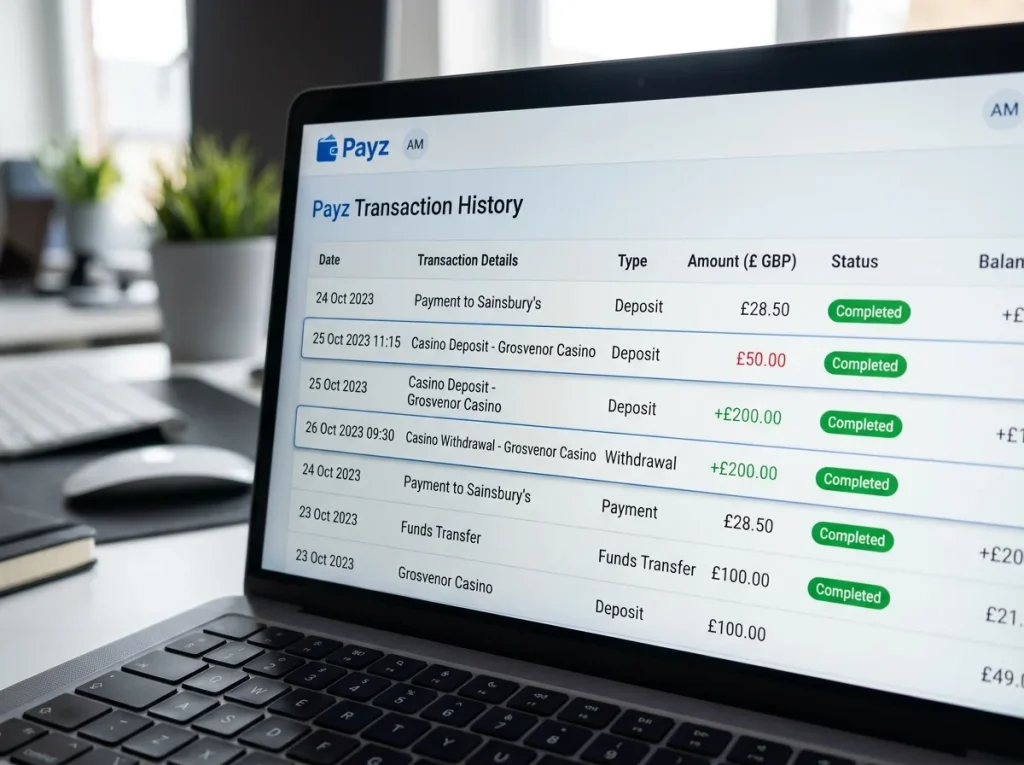
The statement nobody reads until they suddenly need it
A reader contacted me last spring with a simple problem: he needed to reconstruct his last six months of gambling activity for a mortgage application that asked about non-essential outgoings. He had vague memories of deposits and clearer memories of losses but no organised record. He’d never opened the Payz statement export feature, and his casino accounts had wildly inconsistent transaction history depths. Building the picture took most of a weekend and involved correspondence with three operators.
What's inside this guide
That episode is more common than it sounds. Adrian Buckle, Head of Research at UK Finance, described 2024 as “a year of firsts, all pointing to the growing shift towards digital payments. More than half of UK adults used mobile wallets, mobile banking overtook desktop as the main way people access their accounts, and cash fell below 10% of all payments.” Digital payment penetration produces digital transaction records, and reading those records well is now a basic financial literacy skill. PSI-Pay, which operates the Payz wallet, maintains records to a standard appropriate for its £64.97m total assets and its position in the UK e-money market, but the records are only useful if you know how to access and interpret them.
Where to find the statement in Payz
The Payz statement lives in the wallet’s account section under “transactions” or “history” depending on whether you’re using the app or the web interface. The default view shows recent transactions in reverse chronological order, with each line containing date, time, merchant, amount, currency and transaction type.
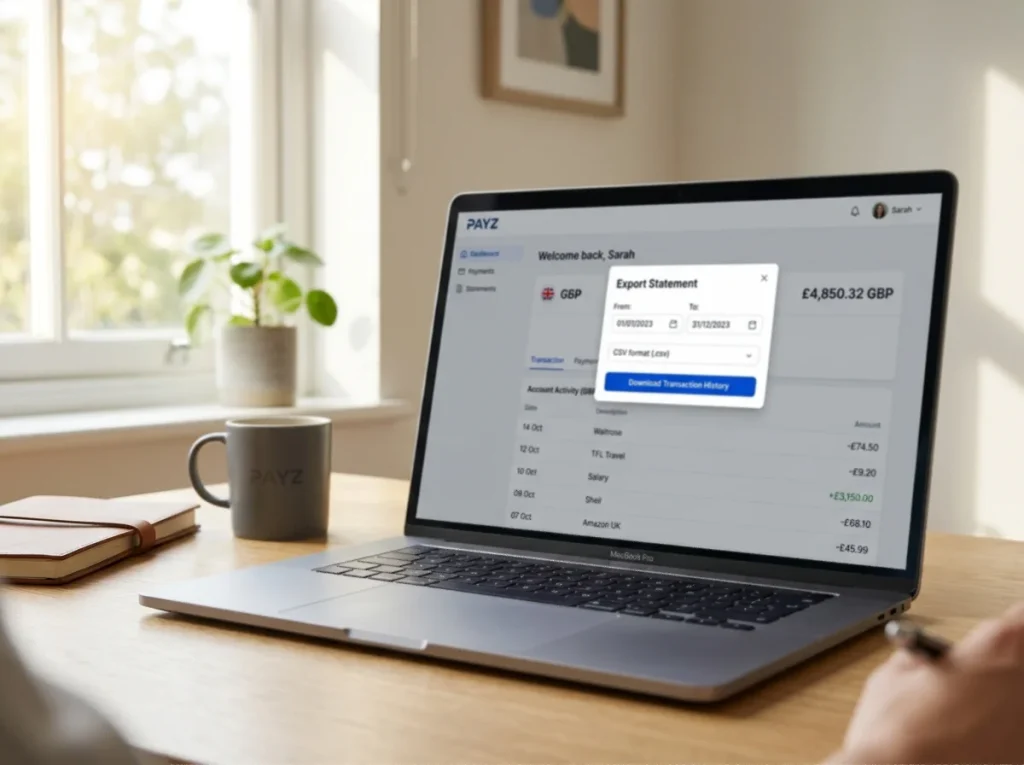
The default view is too short for any serious reconciliation work — typically 30 or 60 days, depending on the interface. To pull longer history, you need the statement export function, which is usually under “documents” or “downloads” in the account section. The export produces a PDF or CSV file covering whatever date range you specify, up to the wallet’s full history retention period.
The retention period for Payz transaction history is longer than most consumer payment products. Account-level records are retained for the active life of the account plus a regulatory retention period — usually six years for AML compliance reasons. Practical access through the in-product export typically reaches back at least two years for most account types; older records may require contacting customer support.
For active casino users, my recommendation is to download a statement export monthly and keep the files in a personal folder. Monthly exports build up to a usable annual record without requiring you to remember to download a year’s worth at once, and they ensure you have a clean copy of the data in your own possession rather than only in Payz’s interface.
What each line actually means
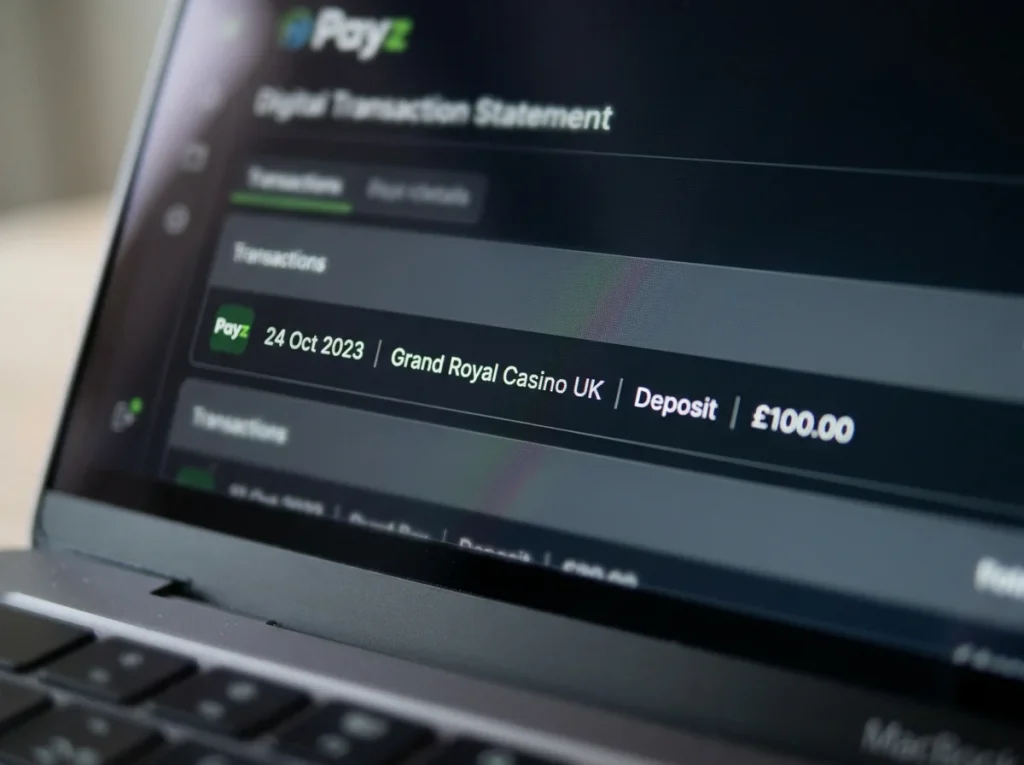
The transaction lines in a Payz statement aren’t always self-explanatory, and casino-related transactions in particular can show up in formats that don’t obviously connect to specific casino activity. Reading them well requires knowing what each field tells you.
The date and time fields show when Payz processed the transaction, which can be slightly different from when the casino’s cashier displayed it as confirmed. Differences of a few seconds are normal; differences of minutes or hours indicate either a delayed instruction or a transaction that was processed during a high-load period.
The merchant field shows the receiving entity. UK casinos appear under their payment-processor descriptor, which may not match the casino’s customer-facing brand name. A casino operating as “Casino Brand X” might appear in the Payz statement as “PayProcessor Ltd” or similar. This is a common source of confusion when reconciling, especially across multiple casinos that share a payment processor.
The amount field is in your wallet’s transaction currency, which may differ from the currency the casino processed in. A £50 casino deposit converted from a EUR Payz balance might show as €57.50 in the Payz statement — the original euro amount before conversion — with a separate line showing the FX adjustment. Tracking this requires reading the conversion lines alongside the deposit lines.
The transaction type field distinguishes between deposits, withdrawals, transfers and adjustments. Casino transactions are typically tagged as “outgoing transfer” for deposits and “incoming transfer” for withdrawals. Reconciliation requires matching outgoing transfers against casino deposit confirmations and incoming transfers against casino withdrawal confirmations.
Reconciling with casino cashier history
The reconciliation process between Payz statements and casino cashier history is the practical exercise that turns transaction data into a usable record. The challenge is that the two systems describe the same events from different angles, with different field structures and different naming conventions.
The standard reconciliation approach is to pull both records in date order — the Payz statement and the casino transaction history — and walk through them in parallel. Each casino deposit should have a matching outgoing transfer in the Payz statement, with matching amount (accounting for FX where applicable) and matching timestamp within a few minutes.
Where reconciliation gets harder is the cases where the records don’t match cleanly. Failed deposits sometimes appear in casino history but not in Payz history (because the failure occurred before the wallet received the instruction). Successful deposits sometimes appear in Payz history with the casino showing them as failed (because of a payment gateway timeout that reconciled on the wallet side but not the casino side). Pending withdrawals can show up in either system before showing up in the other.
For most reconciliation purposes the requirement is to match completed transactions. Failed transactions that left no balance impact don’t need to be reconciled even if they appear in one record. What matters is that every transaction that moved money is accounted for in both records, with the amounts agreeing within the expected FX tolerance.
For tax purposes or formal financial review, the reconciliation should be documented with the matching records preserved. A spreadsheet that lists each transaction with the Payz reference, the casino reference, the amounts on each side, and any FX adjustment is the standard format. This is laborious for high-frequency players but produces a defensible record if any question arises.

Our top casino picks for the UK
- BeOnBetBonus: 100% up to €500 + 100 FS · Payout speed: 1-3 business days
- WinBeastBonus: €5000 + 500 FS + €650 Freebet · Payout speed: 1-3 business days
- NightWinBonus: £900 + 400 free spins · Payout speed: 1-3 business days
- JetsetspinsBonus: 200% Bonus + 100 Free Spins + Free Royal Wheel · Payout speed: 1-3 business days
- DieselwinBonus: Welcome Pack 250% up to £4000 + 200 FS · Payout speed: 1-3 business days
- EvoSpinBonus: 125% up to €2500 + 125 Free Spins · Payout speed: 1-3 business days
- SpinFormulaBonus: 550% Up To £15,000 + 550 FS · Payout speed: 1-3 business days
- Revery PlayBonus: 100% up to€1,000+ 100 FS · Payout speed: 1-3 business days
Exporting for tax or personal finance
UK gambling winnings are not subject to income tax for the player, which simplifies the tax-side reconciliation for casino activity. But gambling activity can still be relevant to other tax processes — anyone running a self-employed business, claiming income-related benefits, or undergoing financial review for a mortgage or loan may need to demonstrate the gambling-versus-non-gambling breakdown of their outgoings.
The standard export for these purposes is a CSV of the Payz transaction history covering the relevant period, filtered to casino-related transactions. The filtering requires identifying which merchant entries correspond to casino activity — straightforward if you’ve labelled them consistently in your records, more involved if you’re starting from scratch.
The export should be paired with the corresponding casino-side statements where available. UK casinos are required to make transaction history available to players on request, including historical activity going back several years. The export quality varies by operator — some provide clean CSVs, others provide only PDFs that require manual extraction — but the underlying data is available.
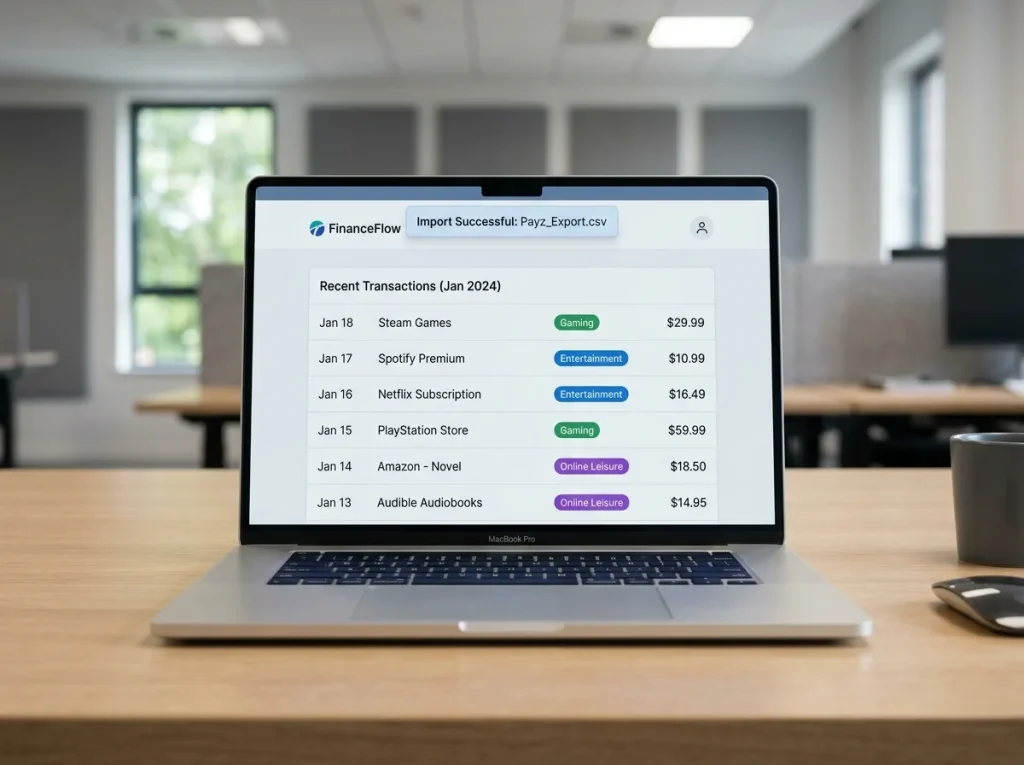
For personal finance tracking, the same exports support category-level analysis of gambling outgoings over time. Most personal finance software can import the Payz CSV directly, categorise transactions automatically based on merchant patterns, and produce trend views of how spending has changed across months or years. This is useful for any player who wants to maintain awareness of their gambling spending without manually tracking individual sessions.
The privacy considerations matter here. The exports contain sensitive personal financial information and should be stored securely. Keeping them in a password-protected folder or an encrypted personal finance application, rather than in plain folders or shared cloud storage, is the safer default.
Holding records for AML checks
Personal record-keeping for AML purposes has become more important as the regulatory environment has tightened. FCA PS25/12, taking effect on 7 May 2026, introduces enhanced safeguarding and reconciliation requirements on payment firms, with a corresponding expectation that customers can provide documentation of fund sources when requested by either the firm or a casino.
The annual safeguarding audit threshold of £100,000 in relevant safeguarded funds, set by the FCA Handbook Instrument FCA 2025/38, defines the firm-side compliance obligation. The customer-side implication is that any player whose wallet activity might intersect with that threshold — through high deposit volumes or large balances held over time — can expect more frequent and more detailed AML inquiries. Being prepared to demonstrate source of funds quickly, with documents on hand, shortens the disruption these inquiries cause.
The records to maintain for this purpose are: monthly Payz statement exports, the casino account statements that correspond to the largest deposits, source-of-funds documentation showing where the money entering the wallet came from (payslips, bank statements, sales proceeds, inheritance documentation as relevant), and a personal log of any unusual activity patterns with explanations attached.

The retention period for personal records should match or exceed the regulatory retention period the wallet itself uses — six years for most AML purposes. After six years, the regulatory requirement for the wallet to retain records lapses, and personal records become the only evidence of historical activity. The KYC documentation that supports these records, and how the casino’s own verification interacts with the wallet’s, is covered in the breakdown of Payz and casino KYC document requirements.
How far back does the Payz statement export reach, and is that enough for a UK self-assessment year?
The in-product export typically reaches back at least two years for most account types, which covers a UK self-assessment tax year comfortably. For longer historical periods up to the wallet"s full retention horizon of around six years, you can request an extended statement from customer support.
Why don"t all my casino chip purchases appear as single lines on the Payz statement?
The Payz statement records wallet-level transactions, which usually means single deposits to the casino balance rather than individual in-game purchases. The casino"s own transaction history tracks the more granular activity of chip purchases, bets and balance movements during play. Reconciling the two requires matching wallet deposits to casino deposit confirmations, then using the casino"s own history for the finer-grained breakdown.
Can I share my Payz statement directly with a lender or mortgage broker?
Yes, statement exports are formatted as standard PDF or CSV files that can be shared with any third party at your discretion. Many lenders accept Payz statements as evidence of financial activity, particularly when paired with corresponding bank statements. Sharing is at your own discretion and the data is your own; the wallet doesn"t provide statements directly to third parties without your authorisation.
ecoPayz Casino Articles: UK Market Trends and Payment Data
Written by the editors at Ecopayz Casino UK.