
Crazy Time Live Casino Game Show in the UK
 Available in GB
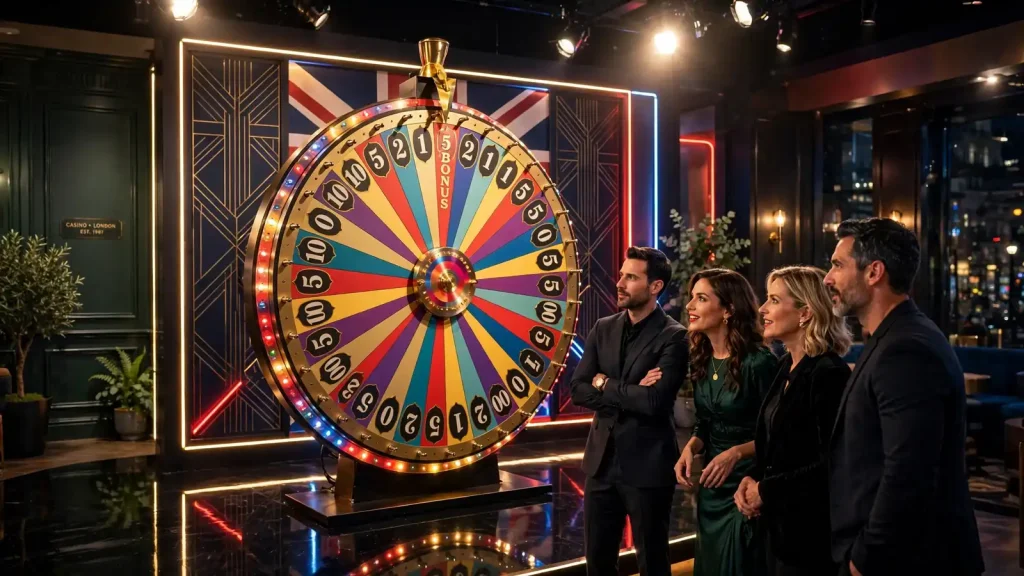
The guide separates the show’s presentation from the gambling product and explains what to verify before relying on a casino’s description.
What's inside this guide
Crazy Time in a UK Casino: The Game-Show Format and What to Check
Crazy Time is presented as a live casino game show, rather than as a conventional slot. That distinction matters. A slot is generally understood through its reels and spin-by-spin interface; a live show puts a studio-style presentation at the centre of the experience. The casino setting is still there, but the product is framed as a hosted broadcast rather than simply a machine game.
That format can shape expectations before a wager is placed. The show’s presentation may make the experience feel closer to watching entertainment than using a standard casino interface. I have seen how that framing works from the other side of the counter: a lively presentation can hold attention, while the underlying activity remains gambling. The camera, host and studio atmosphere do not change that.
A sensible first check is therefore what is actually being offered. “Live” describes the style of the product, not a promise about how a particular casino presents it, what controls its interface provides or whether access is available at a given time. Those details belong to the casino’s own current information. Promotional language is not a substitute for checking the game display and the terms attached to access.
The title also should not be treated as shorthand for every live casino product. Crazy Time has its own identity and presentation; a casino’s broader live catalogue is a separate matter. Nor does the show format, by itself, establish how a game is classified under a particular set of rules. Familiarity with slots, roulette or blackjack does not necessarily explain a live game-show product.
I approach “immersive” as a description of presentation, not of value. A host-led format can make the experience feel active, but it cannot make outcomes predictable or remove the financial risk. The useful distinction is between what the screen shows and what a player can control: presentation belongs to the product; the amount wagered belongs to the player. Gamble only with money that can be afforded to lose.
UK Casino Games: Slots, Live Tables and More
For a UK audience, the practical question is not simply whether a casino advertises Crazy Time. The surrounding conditions matter too, and a polished game page does not answer every question about the operator or the way it serves customers. Those checks should be made separately from impressions formed by the show itself.
The useful starting point is modest: recognise the format, separate presentation from gambling decisions, and assess the casino environment on its own terms.
Not a slot in costume.
Our top casino picks for the UK
- BeOnBetBonus: 100% up to €500 + 100 FS · Payout speed: 1-3 business days
- WinBeastBonus: €5000 + 500 FS + €650 Freebet · Payout speed: 1-3 business days
- NightWinBonus: £900 + 400 free spins · Payout speed: 1-3 business days
- JetsetspinsBonus: 200% Bonus + 100 Free Spins + Free Royal Wheel · Payout speed: 1-3 business days
- DieselwinBonus: Welcome Pack 250% up to £4000 + 200 FS · Payout speed: 1-3 business days
- EvoSpinBonus: 125% up to €2500 + 125 Free Spins · Payout speed: 1-3 business days
- SpinFormulaBonus: 550% Up To £15,000 + 550 FS · Payout speed: 1-3 business days
- Revery PlayBonus: 100% up to€1,000+ 100 FS · Payout speed: 1-3 business days
Crazy Time Casinos in the UK: Licensing Before Branding
A casino can put Crazy Time prominently on its live-games page, use polished studio imagery and describe itself as “UK-friendly”. Those details tell me how the business presents its offer; they do not establish who operates the site or whether it holds the permission required to serve customers in Great Britain. I put the licensing check first. The catalogue comes after.
That order matters because a game’s presence is not a regulatory endorsement of the casino hosting it. A familiar title may appear alongside many other products, but the operator remains responsible for the account, payments and terms attached to the site. Branding can change quickly. The legal entity and the licence behind the service are the points that need to match.
The Gambling Commission requires remote operators serving consumers in Great Britain to hold the relevant licence. For a site advertising Crazy Time to this market, that makes the operator’s UK-facing status a more useful starting point than the game tile, a promotional banner or a claim that the site accepts British customers. A logo is easy to display. A licence is a matter of record.
Match the operator, not just the name on the page
Casino brands and operating companies do not always share a name. A website may use one brand in its header, another company name in its terms, and a separate domain in its payment or account pages. That does not by itself prove anything is wrong, but it does mean that checking only the logo is not enough.
Attention: Checking only a casino’s logo is not enough, as brand names and operating companies do not always share the same name.
I look for the legal business identified in the site’s terms and compare it with the entry on the Gambling Commission’s public register. The licence number should be checked there before a deposit is made. The brand, company and web address should make sense together; if the register entry relates to a different business or does not cover the stated site, the marketing page cannot fill that gap.
This is a practical distinction, not a technicality. A casino can advertise a broad live catalogue while the customer’s contract is with a named operating company. When there is a dispute, the company and its regulatory status matter more than the wording on a banner. “Trusted” is a label. The registered operator is the substance.
A specialist casino review reports that a check of the public Gambling Commission register dated 26 September 2026 did not identify a LuckyPays entry under the LuckyPays brand or the stated domain, including luckypays.io. That is a specific result for that register date and those identifiers, not a general comparison of casino brands. It should not be stretched into a claim about every site offering Crazy Time, nor treated as a permanent statement about a register that can change. The relevant question for any service remains whether its current operator and domain are covered by the required licence.
Deal or No Deal Casino UK: Slots and Licensing
Why the game catalogue comes second
A catalogue is useful for confirming whether a casino lists Crazy Time, but it answers a narrower question: what the site says it offers. It does not show which company is accountable for the service or whether the site is authorised for the British market. The same applies to claims about live dealers, fast registration or a large selection of games. Those features may affect preference; they do not replace the licence check.
There is also a difference between finding a game and finding a suitable operator. A game page may be reachable through a brand’s website, while the terms identify a different company. Reading only the game description leaves the important relationship unclear. In my experience, the dull page containing the operator’s details often tells more than the colourful one promoting a show.
The check should be made against the actual site being considered, not a similarly named brand or an old review. A domain can differ by a few characters, and a brand can have more than one web address. Those differences are precisely why the licence number and the operator’s identity need to be compared with the public register rather than inferred from appearance.
A sensible order of checks
For a UK-facing Crazy Time casino, I would establish the operator’s identity, locate its licence number, and verify that information on the Gambling Commission register before considering the game list. Then the catalogue can be assessed on its own terms: whether Crazy Time is listed, what other live games are available, and what the site says about access. Each answer has a separate job.
Licensing Check
Step 1: Identify Operator
Establish the identity of the operating company from the site’s terms.
Step 2: Locate Licence
Find the operator’s licence number.
Step 3: Verify Register
Verify that information on the Gambling Commission public register before considering the game list.
If the licence details cannot be matched to the operator and domain, a prominent Crazy Time listing does not resolve the uncertainty. Nor does a familiar provider name, a professional-looking studio page or a claim of UK availability. They are evidence of presentation, not a substitute for regulatory status.
The practical sequence is plain: operator first, register second, catalogue third. That avoids treating a game’s popularity as proof about the business hosting it. Branding attracts attention. Verification does the work.
Finding Crazy Time Online: The UK Regulatory Boundary
Searching for Crazy Time on a casino site can make the choice look like a catalogue question: find the game, open its page, and decide whether to play. The regulatory question comes first. A game’s presence on a website does not establish that the operator is entitled to offer it to people in Great Britain.
The UK Gambling Commission oversees gambling across the United Kingdom, including online casino activity. For remote gambling offered to consumers in Great Britain, the relevant test is not where the operator has placed its servers, studios or other key equipment. The Commission’s remit applies regardless of the location of that equipment. A business cannot move the regulatory boundary simply by running its technical operation from elsewhere.
That point matters for live products such as Crazy Time. The screen may show a studio, a host and a game interface, while the commercial relationship sits with an operator serving customers remotely. From the player’s side, the interface is the visible part; the operator is responsible for making the offer. I have seen how easily those two things blur in promotional copy. A familiar game title can create a sense of reassurance that belongs to the product, not necessarily to the casino displaying it.
French Roulette Online Casinos in the UK: Rules
The operator is the relevant link
The UK market is not defined by the language on a site, the currency shown in a menu or the country named in a promotional banner. What matters is whether the operator is offering remote gambling to consumers in Great Britain. The Commission requires such operators to hold the relevant licence, wherever their equipment is based.
The Gambling Act 2005 governs gambling in England, Wales and Scotland; it does not govern Northern Ireland. That distinction is important when describing the British regulatory boundary. Great Britain means England, Scotland and Wales. The Commission’s oversight of remote gambling offered to consumers there is not dependent on the operator being physically located in one of those nations.
In practice, this makes the company behind an online casino more important than the provider of a particular game. Crazy Time may be the reason a person arrives at a site, but it does not replace the operator’s responsibility for the gambling service. A branded game and a regulated gambling offer are different parts of the arrangement.
What the boundary does—and does not—say
A UK-facing page can use British wording and display a well-known game without proving that the underlying operator falls within the UK regulatory system. Conversely, the location of a studio or server outside Great Britain does not, by itself, put an operator beyond the Commission’s reach when it offers remote gambling to consumers in Great Britain.
Remote gambling offered to consumers in Great Britain falls within the Gambling Commission’s remit regardless of where the operator’s servers, studios, or equipment are located.
That is the boundary to keep in view when considering an online casino with Crazy Time. The issue is not whether a game looks local, whether its presentation resembles television entertainment, or whether the site describes itself as international. Those details do not change the rule for remote operators serving the British market.
I treat game availability and regulatory status as separate checks. The first concerns what a casino lists; the second concerns who is offering the gambling and under which authority. Advertising tends to foreground the first because it is easy to understand. The second is less visible, but it is the more consequential distinction.
The Commission issues operating licences to gambling businesses and personal licences to individuals working in relevant roles. That licensing structure reflects the fact that regulation attaches to the people and businesses conducting gambling activity, not merely to a game title or a web page. For an online casino, the operator’s status is therefore the useful point of reference.
Before depositing, the licence number should be checked against the Gambling Commission’s public register. This is a general precaution, not a judgement based on a game’s popularity or presentation. A casino listing Crazy Time is not, on that fact alone, evidence of its regulatory standing.
The practical boundary is straightforward: remote gambling offered to consumers in Great Britain falls within the Commission’s remit even when the equipment supporting it is elsewhere. Crazy Time may be the draw, but the operator remains the regulated link. The distinction is easy to miss. It should not be.
Crash Casino Games in the UK: How the Market Works
Where to Play: Live Casino Games and the Wider Table Selection
Looking for a place to play Crazy Time live is also a reason to look beyond the show itself. A live-casino lobby can be a broader catalogue, with different table formats and games grouped together. The useful distinction is between finding one named title and understanding what else sits alongside it.
Crazy Time is presented as a live game-show experience, with its wheel as the most recognisable feature. That makes it different in feel from a conventional table game, but it still belongs in the wider live-casino environment. A casino may organise its lobby by game type, provider or featured titles; the exact layout varies. The practical point is simple: a prominent tile is not the same thing as a full picture of the live selection.
I tend to read a live lobby as a menu, not as a recommendation. A featured show may be placed at the top because it is visually distinctive, while card games and roulette tables appear in separate categories or further down the page. That can make a casino look centred on one product even when its live offering covers several formats. The catalogue matters more than the banner.
Grosvenor’s history gives one example of how this broader live environment developed. The operator first introduced live casino games in 2013, with card and casino options that included Blackjack, Texas Hold’em and Roulette. Those names illustrate the range that can sit within a live catalogue: familiar table games alongside more show-led formats. They do not, by themselves, establish which titles are currently available in any particular lobby.
Game-Show Formats
Visually distinctive experiences, such as Crazy Time, often featuring a wheel and a host.
Conventional Table Games
Familiar casino options including Blackjack, Texas Hold’em, and Roulette.
Live Casino Lobby
A broader catalogue where games are grouped by type, provider, or featured titles.
That distinction matters when assessing where to play Crazy Time in the UK. The search for a casino featuring the game and the search for a substantial live selection are related, but they are not identical. One is about the presence of a specific title; the other is about the choice around it. A broad catalogue may suit someone who moves between formats, while a player interested only in the wheel may care more about whether the game is easy to locate and clearly identified.
The lobby is also where naming can blur categories. “Live casino” may refer to an entire section, rather than a single game. Within that section, a game-show title, a roulette table and a card table can all appear under the same general label, although the experience differs. The category is broad. The formats are not interchangeable.
For a considered comparison, the useful checks are modest: whether Crazy Time appears as a distinct title, how the live games are grouped, and whether the wider table selection is easy to navigate. This avoids treating a marketing image as evidence of catalogue depth. It also keeps the focus on the actual range, rather than assuming that every casino presenting a live section offers the same games.
Online Casino Games for Real Cash in the UK
A live catalogue is more than a wheel. The surrounding choice can help explain what kind of casino experience a platform is presenting, but it should not be confused with a promise about any particular title’s availability. Start with the game listing; then take in the wider menu.
Crazy Time Casino Strategy: Managing Stakes, Not Predicting Outcomes
A useful Crazy Time casino strategy starts with a boundary: a player can decide how much to stake and when to stop, but cannot make a result more likely by studying previous outcomes. I have seen “strategy” used to sell certainty where none exists. In practice, stake discipline is the part that remains under a player’s control.
Before play, set a total amount that can be lost without affecting bills, savings or other commitments. Divide it into stakes that feel manageable, and decide in advance what will end the session: reaching the budget, feeling frustrated, or simply no longer enjoying the game. A limit only works if it is not revised after a losing run or raised to chase a win. That is where a plan tends to break.
Only gamble with money that can be afforded to lose. That warning is not a ritual disclaimer; it describes the financial reality of gambling. A winning session does not make the next stake safer, and a losing session does not create a debt the game must repay. Stepping away is a decision, not a failed strategy.
What a tracker can—and cannot—tell you
A Crazy Time tracker, where one is available, may organise recorded results or help someone review a session. It cannot turn past outcomes into a reliable forecast. A history of results describes what has already happened; it does not establish what must happen next. I would treat a tracker as a record-keeping aid, not as a staking signal.
Financial Risk
Gamble only with money that can be afforded to lose. A winning session does not make the next stake safer, and a losing session does not create a debt the game must repay.
The same caution applies to casino history and claims about patterns. A sequence that looks meaningful after the event can be persuasive, especially when a player is already hoping to recover losses. But choosing a stake because a particular result seems “due” does not give that result an advantage. Nor does changing the wager after a run of outcomes create control over what follows.
This is the practical limit of a live casino strategy: it can shape exposure, not dictate outcomes. A player might use a fixed stake, or choose to stop after a predetermined loss. Neither approach changes the game’s result. The benefit is narrower and more useful: it can prevent a session from expanding beyond the amount intended.
Slot limits are a separate question
A specialist review reports Great Britain online-slot stake caps of £5 per game cycle for adults aged 25 and over, and £2 for adults aged 18 to 24. The same kind of review notes that these slot limits do not cover roulette or blackjack. Those figures concern online slots; they should not be treated as a general stake rule for every casino game or as a way to predict Crazy Time outcomes.
The label attached to a game matters when considering which rules apply. A game-show format should not automatically be treated as a slot simply because it is played online or offered by a casino. The responsible approach is to keep the distinction clear and not use a slot limit as a personal budget for another type of game.
Casino Dice Games in the UK: How They Work
A tracker may describe a session. A staking plan may constrain it. Neither can promise a result. Keep the wager within a pre-set affordable amount, and stop when that amount is gone. No recovery system.
Free Crazy Time Play: What a No-Deposit Option Does—and Doesn’t—Mean
“Free” can describe different things, and the distinction matters. A practice option lets someone explore a game without staking deposited funds; a promotion may instead attach a benefit to an account or a particular set of conditions. Neither label, on its own, establishes that Crazy Time is available to play free at a particular casino, or that free spins apply to it.
I have seen promotional wording do a lot of work in very little space. “No deposit” may sound like unrestricted access, when the actual offer can be limited by eligibility, expiry conditions or rules about how a benefit may be used. Those details belong to the offer, not to the game itself. A review that repeats the headline but skips the conditions tells only half the story.
Free spins deserve the same distinction. The phrase is common in casino advertising, but it should not be read as proof of a specific Crazy Time feature or promotion. Before treating an offer as relevant, its terms should identify which games qualify, whether an account action is required and what restrictions govern any resulting balance. If the wording does not make that clear, the advertised label is not enough to assess its value.
Do
- Use practice options to explore games without staking funds
- Review the full terms and conditions of promotional offers
Don’t
- Confuse promotional “no deposit” labels with unrestricted access
- Assume free-play labels make paid gambling risk-free
Practice and promotion are not interchangeable. A practice option is for exploring without gambling deposited funds; a promotional benefit is governed by its stated conditions. Neither should be confused with depositing and wagering personal money. “Free” is a description, not a guarantee of access or value.
A casino review can help explain how an offer is presented, but it should separate observed game access from promotional claims. The useful question is not whether a page uses the words “free play”; it is what the option actually permits and what conditions accompany it. Where no option is clearly described, there is no sound basis for assuming one exists.
The boundary is simple: no-deposit language does not remove the need to understand the terms, and a free-play label does not make paid gambling risk-free. I keep those decisions separate. Only gamble what can be afforded to lose.
Crazy Time Bonuses and Deposits: Read the Conditions as Separate Decisions
A Crazy Time casino bonus is an offer attached to an operator’s terms, not a feature of the game itself. I treat the promotion and the deposit as separate decisions: first establish what the offer actually promises, then decide whether the account conditions and payment method make sense without it. A welcome bonus or deposit bonus does not, by itself, make wagering better value.
Mines Casino Game in the UK: What to Know
The headline is only the entry point. The operative wording explains who qualifies, which games count towards any conditions, how winnings are treated and what restrictions apply to withdrawals. Those details can change the practical value of an offer. If Crazy Time is named in promotional copy, that alone does not establish how the game is treated under the full terms. The terms govern. Marketing does not.
A “no deposit” label also needs to be read literally against its conditions: it describes an offer that may not require an initial deposit, not a promise of unrestricted cash or a particular payout. Availability and eligibility depend on the operator’s published terms; a search for a Crazy Time no-deposit bonus is not evidence that one is currently offered.
Depositing is a separate stage with regulatory checks. Operators must verify a customer’s age before allowing funds to be deposited into a gambling account. New customers must also be prompted to set a financial limit before their first deposit, with account-level limit controls available. I regard that prompt as part of the decision, not an optional extra to click past.
Payment rules matter too. Remote gambling operators cannot accept credit-card payments for gambling, including credit-card funding routed through a money service business. They also cannot accept wallet payments where credit-card funds can be used for gambling. A payment method’s label is not enough; the funding route matters.
Before depositing, the operator’s licence number should be checked on the UK Gambling Commission’s public register. That check is separate from judging whether a bonus is attractive. And regardless of the offer, only gamble what can be afforded to lose. No promotion changes that.
Before Depositing
- Check the operator’s licence number on the UK Gambling Commission register
- Set a financial limit before the first deposit
- Verify that the payment method is not a credit card or a credit-funded wallet
- Review the full conditions of any welcome or deposit bonus
Crazy Time Rules and Multipliers: Check the Game Information, Not the Ad Copy
When checking Crazy Time’s rules, I separate the game’s own information from the language used to sell it. The rules and multiplier details displayed with the game are the place to establish what its terms mean. A casino description can summarise the experience, but it is not a substitute for the game information.
That distinction matters when a page promises “big multipliers” or highlights “scores”. Those are promotional labels until the game’s information explains what is being counted and how the displayed figures relate to play. I would not infer a payout, a likely result or a rule from a headline alone. Read the wording attached to the relevant game information, rather than treating a graphic or slogan as a complete explanation.
“Trusted” is also a claim, not a game rule. A polished page or familiar-sounding description cannot establish how the game works. Nor does a multiplier display, by itself, say anything about the likelihood of a result. Keep those questions separate.
If the information shown is unclear, pause rather than filling gaps with assumptions. Casino scores may refer to displayed figures or results, but the label needs context from the game itself. Promotional copy can compress distinctions that matter; the underlying explanation should make them clear. No guesswork.
Chicken Road Game in UK Online Casinos
I have found it useful to read the rules before treating any feature as meaningful, then compare the exact terms in the game display with the casino’s description. If the two seem to say different things, rely on neither an advert nor an interpretation built from a clipped phrase; seek clarification through the operator’s stated information channels before playing.
Rules do not predict outcomes. Multiplier information is not a strategy, and a score or result display is not a promise about what comes next. Gamble only with money that can be afforded to lose.
Crazy Time Demo Play: A Separate Way to Explore the Game
A demo can help establish whether Crazy Time’s live-show presentation is comfortable to follow before any money is involved. It is a way to inspect the screen, the pace of the presentation and how clearly the available information is displayed—not a preview of what a real-money session will deliver.
I treat demo access as a separate product feature, not a promise attached to every casino listing. Some sites may provide a version to explore; others may not. Availability can also depend on how the operator presents the game. A page describing a “demo” should make clear whether it opens a playable practice version or merely shows information about the game.
The distinction matters because a practice session does not reproduce the financial decisions of real-money play. It can familiarise someone with the interface, but it cannot establish that future results will resemble the demo or that a particular approach will work. Different purpose. Different stakes.
A demo version allows a player to inspect the screen, the pace of presentation, and the display of information without financial risk.
Searches that call Crazy Time a “slot” do not settle its classification. The label used in a search or promotional page is not a substitute for the game’s own information or the applicable rules. Demo access is best understood narrowly: a chance to explore the presentation, not evidence about payout expectations or a route to guaranteed outcomes.
I have seen promotional wording blur that boundary. “Try before you play” sounds reassuring; what it really offers depends on the version made available and its terms. If play moves from demo to wagering real money, the nature of the decision changes. Only gamble what can be afforded to lose.
Online Slot Rules in Great Britain: Limits, Speed and Safer-Gambling Controls
Online gambling safeguards are often presented as one general bundle, but some apply specifically to online slots. That distinction matters for Crazy Time: the slot rules described here are not evidence that Crazy Time itself is an online slot. The game’s own classification and information should be assessed separately from market-wide controls.
JetX Casino Game in the UK: A Practical Guide
A specialist review reports online-slot stake caps of £5 per game cycle for adults aged 25 or over and £2 for those aged 18 to 24. These figures concern slot play, not every casino game. A stake cap also does not set a sensible personal budget; it only limits the amount that can be staked in the relevant game cycle. I treat the two questions separately. Different things.
Speed controls also apply to online slots. Autoplay is prohibited, and at least 2.5 seconds must pass from the start of one game cycle before another can begin. These controls limit how quickly slot play can be repeated; they should not be read as a description of the pace or mechanics of a live game-show product.
Licensed remote casinos have duties beyond game controls. Age must be checked before a customer is allowed to deposit. Before a new customer makes a first deposit, the operator must prompt them to set a financial limit, and account-level limit controls must remain accessible. Those settings are operational safeguards, not a promise that gambling will stay within a chosen budget.
Live Dream Catcher Casino UK: What to Check
Payment restrictions form another part of the framework. Gambling operators cannot accept credit-card payments for gambling, including credit-card funding routed through a money service business. They also cannot accept wallet payments for gambling where that wallet permits credit-card funds to be used. The point is the funding source, not merely the label shown at checkout.
Self-exclusion and account controls are not optional extras for UK-licensed casinos. Operators must provide responsible-gambling tools, including the ability to self-exclude. Limits and exclusion tools serve different purposes: a limit can restrict account activity, while self-exclusion is intended to prevent further gambling through the relevant operator or scheme. Their presence is a regulatory requirement, not proof that a particular game is safe for every player.
There are also duties when something goes wrong. UK Gambling Commission licensees must operate an internal complaints process and give access to an approved Alternative Dispute Resolution service. The RET levy—covering research, education and treatment—is another required contribution from operators. These obligations sit behind the customer-facing site, even when its marketing puts the game or promotion first.
The UK Gambling Commission is the sole regulator for commercial gambling in Great Britain. It issues operating licences to businesses and personal licences to individuals working in the regulated industry. In practice, the rules therefore reach beyond the design of a game: they govern the operator’s systems, payments, customer controls and routes for resolving complaints.
For a player, the practical distinction is between a game feature and a market safeguard. Slot speed rules, stake caps and the autoplay ban describe online-slot regulation; they do not establish Crazy Time’s category. Account controls, self-exclusion, complaints access and payment restrictions concern the licensed operator’s responsibilities. The boundary is important. The game and the framework are not interchangeable.
Only gamble with money that can be afforded to lose.
What are the online slot stake limits in Great Britain?
The limit is £5 per game cycle for adults aged 25 and over, and £2 for adults aged 18 to 24. These limits do not apply to roulette or blackjack.
Are online casino games licensed and regulated?
Yes. The UK Gambling Commission regulates online gambling, and remote operators serving consumers in Great Britain must hold the relevant licence.
Is LuckyPays licensed by the UK Gambling Commission?
The Commission’s public register dated 26 September 2026 did not identify an entry under the LuckyPays brand or its stated domain, including luckypays.io. Check the current register against the operator and domain before using the site.
Games
Prepared by the Ecopayz Casino UK editorial staff.