
Pay by Phone Bill at UK Casinos: How It Works
 Available in GB
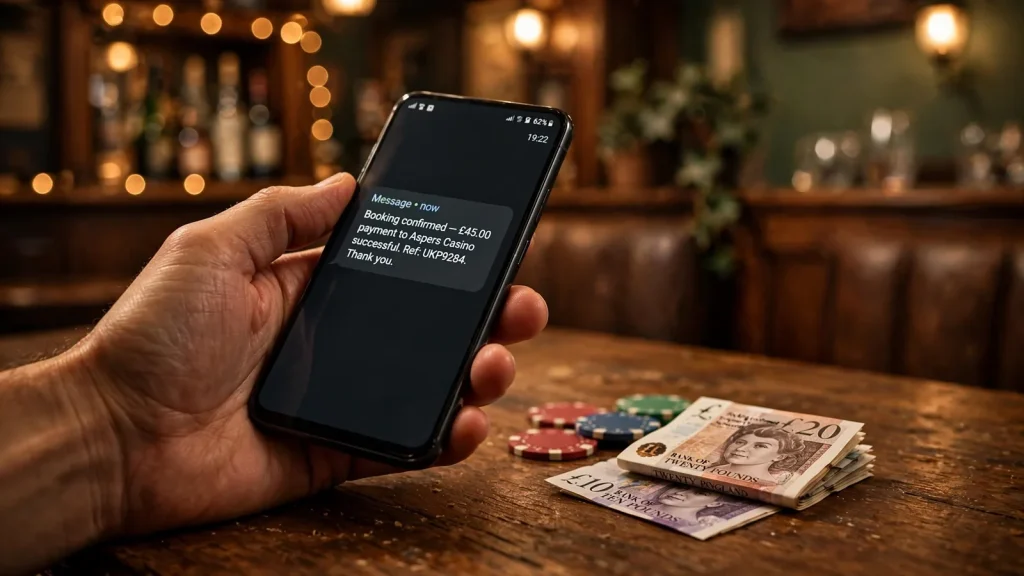
Payforit uses an SMS code to confirm a casino deposit, with the charge handled through a mobile contract bill or prepaid credit.
What's inside this guide
How Payforit Charges a Casino Deposit to a Phone
A casino deposit by phone bill is not authorised by entering a card number or signing in to a bank. With Payforit, the payment starts in the casino cashier: the player selects Payforit, enters a mobile number and waits for a text message containing a confirmation code. Submitting that code completes the confirmation step for the deposit.
That sequence matters. Entering a number identifies the phone account to be charged, but it does not by itself confirm the transaction. The SMS is the point at which the phone user is asked to approve it. Until the code is submitted, the deposit has not gone through the stated Payforit confirmation flow. I have found that this distinction is easy to miss when the cashier presents the method as a single button labelled “Pay by phone”. The button begins the process; the code completes it.
Once confirmed, the charge is handled through the phone account rather than a separate payment card. The way it appears depends on the type of mobile plan. On a monthly contract, the deposit is added to a later phone bill. With pay-as-you-go, the amount is taken from prepaid credit. In either case, the casino deposit and the eventual appearance of the charge on the phone account are linked parts of the same transaction, but they are not the same screen or account record.
The cashier’s confirmation page is therefore only one side of the record. The casino account shows the deposit, while the mobile account shows the related charge according to the plan. If the two do not appear at the same time, that alone does not establish that the payment has failed; the relevant status is the one shown in the casino account and any message received during the confirmation process. The practical point is to keep the transaction details available until the deposit is accounted for.
£1 Minimum Deposit Casinos in the UK: What to Know
A useful way to read the flow is as three decisions. First, the casino cashier identifies Payforit as the chosen route. Second, the mobile number directs the request to the phone account. Third, the SMS code records confirmation from that phone. Each step has a different purpose, so a number entered incorrectly, a code left unsubmitted, or a message that is never received can interrupt the process before the deposit is complete. The safe interpretation is not to repeat the transaction on assumption alone; first check whether the casino has recorded the original attempt.
The confirmation message is part of the payment mechanism, not a casino bonus code or a general login prompt. It is tied to the specific payment request. That is why the details displayed around the SMS should be read before the code is entered: the message is the approval stage, not a formality after the money has moved. A “one-tap” description may make the process sound simpler, but the actual transaction still depends on an explicit confirmation.
Payforit is sometimes discussed alongside Boku because both involve a phone and an SMS step, but the mechanics should not be treated as interchangeable. A Boku deposit also requires confirmation by text before funds move. That shared feature does not mean every casino supports both services or presents them in the same way; the cashier’s displayed method determines which process applies. For a Payforit transaction, the relevant sequence remains selection, mobile number, confirmation text and submitted code.
The wording on a phone statement or bill may not mirror the casino’s brand name exactly. The deposit is routed through the phone-payment process, while the casino records the amount as funds added to its account. Those records serve different purposes: one tracks the charge through the mobile account, and the other tracks the casino balance. Keeping that distinction clear helps explain why checking only one account may not answer every question about a payment.
In operational terms, Payforit makes a casino deposit by using the phone account as the charging route and SMS as the confirmation mechanism. The contract plan determines whether the charge is added to a future bill or deducted from prepaid credit. No card entry. No bank transfer. The confirmation code is the decisive step.
Payforit Deposit Process
Step 1: Method Selection
The player selects Payforit in the casino cashier.
Step 2: Identification
The player enters their mobile number to identify the phone account to be charged.
Step 3: Confirmation
The player receives a text message with a code and submits it to complete the deposit.
Our top casino picks for the UK
- BeOnBetBonus: 100% up to €500 + 100 FS · Payout speed: 1-3 business days
- WinBeastBonus: €5000 + 500 FS + €650 Freebet · Payout speed: 1-3 business days
- NightWinBonus: £900 + 400 free spins · Payout speed: 1-3 business days
- JetsetspinsBonus: 200% Bonus + 100 Free Spins + Free Royal Wheel · Payout speed: 1-3 business days
- DieselwinBonus: Welcome Pack 250% up to £4000 + 200 FS · Payout speed: 1-3 business days
- EvoSpinBonus: 125% up to €2500 + 125 Free Spins · Payout speed: 1-3 business days
- SpinFormulaBonus: 550% Up To £15,000 + 550 FS · Payout speed: 1-3 business days
- Revery PlayBonus: 100% up to€1,000+ 100 FS · Payout speed: 1-3 business days
Why Phone-Bill Payments Are Mainly a Mobile Option
Payforit belongs to the mobile side of casino payments because the charge is connected to a phone account. That makes it a different proposition from entering card or e-wallet details on any device. In practice, Payforit is generally reserved for mobile players; it is not a general payment route that can be assumed to appear whenever a casino account is opened on a computer.
The distinction is about the payment context, not the casino game. A mobile casino may offer several ways to fund an account, but a phone-bill option depends on the phone account being relevant to the transaction. The device and the source of payment are therefore linked in a way they are not with a standard card payment. A desktop browser does not, by itself, provide the same mobile context.
That does not mean every casino site accessed on a phone will offer Payforit. “Mobile casino” describes how the site is being used; it is not a promise that a particular payment method is available. The operator’s cashier determines which options can be used for the account. I have always separated those two questions: whether the casino works on a mobile device, and whether its cashier supports a phone-bill deposit. One does not prove the other.
The same point applies when a site has both a mobile website and an app. Using a smaller screen or a touch interface does not turn every payment route into a phone-bill payment. Payforit is relevant where the payment option is presented for a mobile player and the phone account can be used for the charge. If the cashier does not show it, the fact that the account is being viewed on a handset is not enough to make it available.
This is why “pay by phone bill” can sound broader than it is. The phrase may suggest that any casino deposit can simply be added to a telephone account, regardless of the device or account setup. The more useful distinction is narrower: Payforit is a mobile-oriented payment option, and its suitability depends on the connection between the player’s mobile use and the phone account being charged. The phone is not merely a small screen for the casino; it is part of the payment context.
£2 Minimum Deposit Casinos in the UK: How It Works
For someone looking at mobile slots or other casino games on a handset, the practical question is not whether the casino is described as mobile-friendly. It is whether Payforit is actually offered in that casino’s payment choices. A mobile site can be designed to work well on a phone while relying on other deposit methods. Conversely, a cashier may present a phone-bill option to eligible mobile players without making that option a general feature for desktop use. The label on the casino’s home page is not enough to settle it.
I also avoid treating the word “mobile” as a synonym for “phone bill”. It can refer simply to a site that adapts to a phone screen. Pay-by-mobile refers to a payment route associated with the phone account. Those are related ideas, but they describe different parts of the experience: one is how the casino is accessed, the other is how a deposit is funded. Confusing them creates the wrong expectation before the cashier is even opened.
A computer can still be useful for managing a casino account, while a phone may be the relevant setting for Payforit. That does not establish that the method will transfer between devices or remain available across every version of a site. The payment choice belongs to the account’s live cashier, not to a general assumption about what a mobile casino ought to support. Availability can be specific to the operator and the account.
The distinction matters most when a player starts on one device and continues on another. A casino account may be the same, but the payment route shown can depend on the circumstances in which the cashier is accessed. I would not infer from seeing Payforit during mobile use that it must also appear on a desktop, or infer from its absence on a computer that the casino has no mobile option. The dependable point is simply that Payforit is generally aimed at mobile players.
That is the limit of the claim. A phone-based route is not automatically available to every mobile customer, and a mobile casino is not automatically a phone-bill casino. Device fit first. Payment availability second.
£4 Minimum Deposit Casinos in the UK: What to Know
Phone-Bill Casinos: What the Cashier Actually Offers
A casino can describe itself as supporting pay by phone, but the practical test is whether Payforit appears as a deposit option in its current cashier. I treat the cashier as the live list of routes available to that account, not as a permanent feature of the brand. Payment options can differ between operators and can change, so an old review or a page describing a method is not confirmation that it is available now.
The useful distinction is between a method a casino mentions and a method its cashier lets an account select. A page may discuss phone-bill deposits in general, while the actual payment screen may show only card or account-based options. Conversely, a method may appear only after the account is signed in or the deposit process has begun. The cashier is where the choice becomes concrete.
That is why a search for casinos that take payment from a phone bill should not end with a list of names. The relevant question is whether Payforit is visible for the account, in the cashier being used, at the time of deposit. A general statement about online casinos accepting pay by phone bill does not establish that every customer, device or account will see the same menu. Marketing language is broad; the payment screen is specific.
Read the method names, not just the headline
A cashier may display several routes side by side. A specialist review of current payment options has listed Visa and Mastercard, as well as Skrill, Neteller, PaysafeCard and some major cryptocurrencies. That is a reported set of methods, not a promise that each one appears at every casino. The operator’s own live cashier determines what can be selected for a particular account.
The labels matter. A phone-bill option is not the same thing as a debit card, an e-wallet or a prepaid voucher, even if each is presented as a way to fund the same casino balance. The cashier may group methods under broad headings, but the details belong to the named route: its stated deposit conditions, any displayed charge, and the processing information attached to it. The method name alone does not settle those terms.
Payment options, including fees and limits, are determined by the operator’s live cashier and can vary between accounts and operators.
I have seen payment copy make a list sound more universal than it is. “Multiple ways to pay” is a description of a menu, not evidence that every route is available or interchangeable. Availability, fees, minimums, maximums and processing times depend on the selected method and the live cashier. A payment option should therefore be judged on the details shown for that option, rather than on a casino’s general payment page.
The card rule is not a loophole
There is one boundary that should not be blurred by a cashier’s layout. UK Gambling Commission rules bar remote gambling operators from taking credit-card payments for gambling. That remains the case when the payment is routed through a money service business. Putting an intermediary between a credit card and a gambling account does not turn the underlying credit-card funding into an allowed casino payment.
This is different from seeing a card brand in a cashier. Visa or Mastercard can refer to a debit card, and the brand name alone does not tell the customer which card type is being used. The distinction is about the source of funds, not merely the logo on the screen. Credit cards must not be used to fund online gambling in Great Britain, including indirectly through a money service business.
The industry wording can be slippery here. A “card payment” sounds like one category, but the regulatory treatment depends on whether it is credit or debit. Cashiers and payment instructions need to make that distinction clear; a familiar logo is not a reason to assume that every card product is permitted.
Casinos That Accept Pay N Play in the UK
What to confirm before choosing
For a phone-bill casino in the UK, the practical check is narrow: look for Payforit in the current deposit cashier, then read the conditions attached to that selection. A payment page elsewhere on the site may explain the method, but it cannot confirm the options currently presented to the account. Nor does the presence of other methods establish that Payforit is available alongside them.
The same discipline applies when comparing routes. A cashier can show several deposit choices without giving them the same cost, timing or limits. Those details are method-specific and may be revised. A specialist review can help identify what an operator has been reported to offer, but it is not a substitute for the live payment screen.
For a deposit by phone bill, the deciding evidence is the selectable Payforit entry and its displayed terms. For cards, the credit-card restriction remains in force regardless of routing. Clear enough.
The £30 Ceiling and the Limits Behind It
The £30 figure is a ceiling on a single Payforit transaction, not a suggested deposit and not a measure of what a player can afford. The Phone-paid Services Authority sets that per-transaction cap. In practical terms, it limits the size of one payment through this route; it does not establish a casino account’s overall deposit allowance or say what amount is sensible for an individual.
A specialist review describes Payforit deposits as having minimums in the £3–5 range and a maximum of £30. That range is a useful indication, not a promise that every cashier will offer the same options. The operator’s current cashier is the place to confirm the minimum and maximum shown for the account. A payment method can be subject to more than one control: the phone-payment ceiling, the casino’s own transaction settings and any financial limits applied to the account.
Do
- Check the live cashier for the current minimum and maximum deposit amounts.
- Review account-level financial limit controls before depositing.
Don’t
- Assume the £30 per-transaction ceiling is an invitation to split a larger payment.
- Treat the indicative £3–5 minimum range as a universal promise.
I have seen payment pages make a method look straightforward while leaving the important qualification in the amount selector or account settings. The advertised maximum is not necessarily the amount available to every customer. A lower maximum may appear, or the selected amount may fall outside the cashier’s permitted range. Fees can also affect the cost of proceeding. The live cashier should therefore be checked for its displayed minimum, maximum, fees and account-level financial-limit controls before a deposit is made.
The £30 cap is not an invitation to divide a larger intended payment into repeated transactions. It is a limit on each transaction, and it should be treated as such rather than as a puzzle to work around. Nor does the cap mean the casino must accept a payment at that value: the account’s own controls and the amount offered in the cashier still matter. Limits are part of the payment decision, not fine print to revisit after pressing confirm.
There is another distinction that matters: a deposit limit is not the same as a personal financial limit. The first concerns what the cashier will permit for a particular payment. The second is an account control intended to shape how much can be deposited. New remote customers must be prompted to consider setting a financial limit before their first deposit, and the relevant account-level facilities must remain accessible afterwards. That prompt should be treated as part of opening and using the account, not as an optional afterthought once payment decisions have already been made.
From an operational point of view, the cashier’s displayed range and the account’s financial controls answer different questions. The cashier shows what the chosen method can accept at that moment. The account controls show whether a deposit would remain within the limits set for that customer. A payment can fit under the Payforit ceiling and still be blocked by an account limit. That is not a contradiction; the controls serve different purposes.
I would check the full set of figures on the live payment screen before proceeding, then check the account’s limit settings separately. This matters particularly where a customer has changed a limit or where the cashier displays a different amount from the one expected. The current information takes precedence over a remembered figure or a general description of Payforit. Small print matters.
For anyone considering a pay-by-phone deposit at a UK casino in 2026, the useful takeaway is narrow: £30 is the per-transaction ceiling, while the actual minimum, available maximum, fees and account controls need to be confirmed in the current cashier. The specialist-review range of £3–5 is indicative rather than universal. A deposit that fits the payment method’s ceiling is not automatically affordable, and the financial-limit prompt exists to make that distinction visible before the first payment.
£5 Minimum Deposit Casinos in the UK: What to Know
Which UK Casino Cashiers Still Show Payforit
A specialist review identifies Kwiff, NetBet, JackpotJoy and Virgin Games as operators whose cashiers show Payforit. That is a useful shortlist, not a standing guarantee. Payment menus are operational settings: an operator can change what it accepts, and the option visible on one account may not be available to another. The live cashier is the deciding record.
I treat those names as places to check, not as a ranking of the best casinos that accept payment by phone. A method appearing in a review does not establish that it remains enabled today, nor that every customer will see it. The difference matters. A published list can be accurate when compiled and still lag behind a changed cashier.
The practical check is narrow. Sign in to the account, open the deposit area and look for Payforit among the payment methods offered there. The operator’s own cashier should take precedence over a third-party list, search result or older page. If Payforit is absent, the name on a shortlist cannot make it available; if it appears, the amount and terms shown in that account are the relevant ones.
That distinction also applies to casino apps. A brand may operate a mobile app, but the presence of an app does not by itself prove that Payforit is enabled within it. Availability needs to be confirmed in the cashier attached to the account and device being used. The same applies when a method appears on an operator’s website but not in its app, or the other way round.
There is a reason payment pages are less stable than operator names. The brand can remain familiar while its payment arrangements change. A cashier is not a permanent catalogue; it is a live part of the account, affected by the operator’s current setup and the options presented for that customer. “Accepted here” is therefore a statement with a time and account attached. Without those, it is only a lead.
For a current UK shortlist, the four names from the specialist review are Kwiff, NetBet, JackpotJoy and Virgin Games. Each should still be checked directly before a deposit. No assumption should be made that all four show Payforit at once, that the method appears for every account, or that a past listing guarantees future availability. One check, at the point of use.
Paying by Phone Bill Versus Other Deposit Routes
Choosing Payforit over a debit card changes where the cost lands and what the account can do afterwards. A phone-bill deposit is charged to the mobile account, while a debit-card deposit comes from the bank account. Payforit deposits are instant, but Payforit cannot be used to withdraw casino funds. The deposit route and the payout route are separate decisions.
A specialist review describes debit-card deposits at UK casinos as free and more widely accepted than Payforit. That makes a card the more flexible option where it appears in the cashier; Payforit is useful when charging the phone account is the specific preference. The difference is practical, not a claim that every casino offers the same methods. I have found it safer to treat payment logos in general advertising as a starting point, not proof that a method is available for a particular account.
Boku, e-wallets and Paysafecard are also named as alternatives in specialist reviews. Their presence should not be assumed at every casino, and Boku is not a route for moving credit-card funds into gambling. British rules bar licensed gambling operators from taking credit-card payments for gambling, including when a money service business sits between the card and the casino. An e-wallet does not make that prohibited funding route acceptable.
Payforit’s main trade-off is therefore clear: it can put a deposit on a phone account, but it does not solve withdrawals and its acceptance is narrower. A debit card may be simpler for deposits and more widely available, but the cashier still determines the options and terms attached to an account. Before a first deposit, a new customer must be prompted to consider a financial limit; payment convenience should not replace that decision.
Credit Card Ban
UK Gambling Commission rules prohibit the use of credit cards to fund gambling, including indirect payments through money service businesses.
I also separate the deposit method from the payout plan. Before funding an account, the available withdrawal route, account details and any identity checks matter, since Payforit itself cannot return winnings to the phone bill. The method that gets money into a casino is not automatically the method that gets money back out. That distinction is easy to miss.
Phone-Bill Deposits and Slot Play
“Phone bill slots” can sound like a separate kind of game. It is not. Payforit is a way to fund a casino account; it does not identify a slot, change how a game works, or guarantee that a particular title is available. The cashier handles the payment choice, while the casino’s games section determines what can be played.
I have seen the distinction blurred in promotional copy. A payment method may be presented alongside a slot offer, but that does not mean deposits made through that method qualify for the offer. Specialist casino reviews report that most UK casinos exclude Payforit deposits from welcome bonuses and other promotions. That is an important condition, not a detail to infer from an advert.
The practical point for slot-focused play is to separate three things: the deposit route, the money credited to the account, and any promotional balance or offer. A Payforit deposit can fund ordinary play, but a bonus may not attach to it. If a promotion matters, its terms need to say whether this deposit method is eligible before the payment is made. A banner alone does not settle that.
This is also why searches for slots that accept phone-bill payments can be misleading. Games do not process the phone charge themselves. The casino’s cashier determines whether Payforit is available for the account; the promotion terms determine whether that deposit counts towards an offer. Those are separate decisions.
I would read the payment terms and the offer terms as two different documents, even when they appear on the same page. The distinction is easy to miss when “welcome” language sits beside a deposit button. It does not make the deposit bonus-eligible.
No special slot category. Just a funding route, with an offer condition attached—or not.
Vodafone and giffgaff: Network Charges Are Not Casino Fees
When a casino deposit is charged through a mobile account, the amount shown by the casino and any amount handled by the network are separate parts of the transaction. A casino’s cashier sets out its own payment terms; a network processing fee, if one applies, is a charge associated with the mobile payment route. Treating both as a single “casino fee” can make a phone-bill transaction look more expensive for the wrong reason.
A specialist review of Boku payments notes that a mobile network may add a processing fee, with the amount depending on the network and tariff. That point is specific to Boku. It should not be read as evidence that Vodafone or giffgaff currently supports Boku or Payforit at a particular casino, or that either network applies the same charge to every transaction. Support and any fee need to be checked against the live payment details for the account being used.
I would keep the two questions separate: what does the casino say it will charge, and what might the network add? A casino cashier or its payment terms are the place to check the operator’s own charges. The relevant network terms are the place to check whether a processing fee applies to the mobile route and how the tariff affects it. A label in the cashier does not, by itself, settle both questions.
Casino Payments: Deposits, Withdrawals and Methods
This distinction matters for searches about paying a casino by phone bill on Vodafone or giffgaff. A network name alone does not establish that a payment method is available, and a fee described for Boku cannot simply be assigned to Payforit. Nor should a network-side amount be mistaken for money retained by the casino. The route and the account terms decide what applies.
Separate line items. Different parties.
Topping Up a Casino Account from Phone Credit
“Top up” can describe adding money to a casino balance, but with Payforit the underlying funds come from the mobile account. The difference between a monthly contract and pay as you go is where the charge lands.
On a contract phone, a Payforit casino deposit is added to a future phone bill. It is not taken from a separate pot of prepaid credit at the point of deposit; the charge appears with the other amounts billed by the mobile provider. The casino balance is funded through the phone account, while the cost is settled later through the bill.
With pay as you go, the deposit comes out of prepaid phone credit instead. That means the available credit is the source of the casino funding, rather than a charge being carried forward to a monthly bill. In practical terms, the same Payforit label can therefore represent two different payment contexts: a later bill charge or a deduction from a prepaid balance.
I have found that “top up by phone bill” can sound as if the casino itself extends credit. That is not what the term means here. It describes the route used to fund the casino account, not a loan from the operator. The contract or prepaid arrangement with the network determines how the phone-side charge is accounted for.
This distinction matters when reviewing a transaction afterwards: a contract user looks for the charge on a later bill, while a pay-as-you-go user checks the remaining prepaid credit. Different source. Same deposit route.
Three and Pay-by-Phone Deposits: Check the Live Cashier
Three should not be treated as automatic confirmation that a casino will accept a pay-by-phone deposit. Availability depends on what the operator currently shows in its cashier and whether the payment route can process the transaction on that network. A method described on an older review page may no longer be offered, or may not appear for a particular account.
I treat the cashier as the deciding point: it shows whether Payforit or another phone-based option is actually selectable before a deposit is started. The network name alone does not establish support. If the method is absent, there is no reliable basis for assuming that changing a handset setting or trying again will make it available.
Boku is a separate payment option, so its conditions should not be read as confirmation of Payforit support. A specialist review notes that a mobile network may add a processing fee to Boku transactions; the amount depends on the network and tariff. It also notes that the available phone credit has to cover both the deposit and any such fee for the payment to succeed. Those terms need checking against the live offer, rather than being assumed to apply identically to every Three customer.
Before funding a casino account, the operator’s terms and cashier should also be checked for the account’s withdrawal route and any outstanding identity requirements. Pay-by-phone availability is about depositing, not proof that winnings can be returned by the same route. New customers should consider a financial limit before their first deposit; the account’s limit controls must remain accessible afterwards.
The practical rule is simple: confirm the named method in the live cashier, then read its displayed conditions. No assumption from the network name alone.
Which UK casinos still accept Payforit in 2026?
Payforit is listed as available at Kwiff, NetBet, JackpotJoy and Virgin Games. Check the casino’s current cashier to confirm it is still offered for your account.
Why did my Payforit deposit fail at a UK casino?
The payment may not complete if the mobile number was entered incorrectly, the confirmation code was not submitted, or the text never arrived. Check your casino account for the status of the original attempt before trying again.
Is there a maximum deposit amount with Payforit at UK casinos?
Yes. Payforit deposits are capped at £30 per transaction, and typical minimum deposits are £3–5. Check the cashier for the limit that applies to your account.
Can I withdraw casino winnings to my phone bill with Payforit?
No. Payforit is for deposits, not withdrawals; UK-licensed casinos may offer withdrawals by debit card, bank transfer, PayPal or e-wallet.
How does Payforit work at a casino deposit?
Select Payforit in the cashier, enter your mobile number, then submit the confirmation code sent by SMS. The deposit is charged to your monthly phone bill or deducted from your Pay As You Go credit.
What are the withdrawal limits when using a Payforit casino?
Payforit cannot be used for withdrawals, so winnings must be paid out through another method available to your account. Withdrawal limits depend on the method and operator; check the live cashier and current terms before depositing.
Payments
Created by the "Ecopayz Casino UK" editorial team.