
Live Blackjack Online in UK Casinos: Rules and Safety
 Available in GB
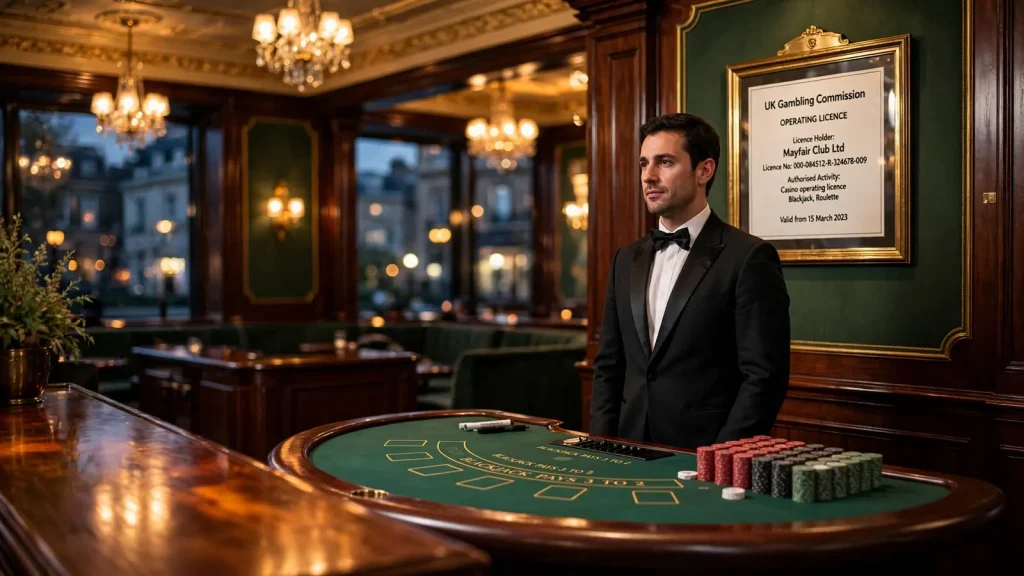
A practical guide to UK licensing, live table formats, round mechanics, account controls, strategy and bonus conditions.
What's inside this guide
What a UK Blackjack Casino Licence Actually Covers
A blackjack table can carry a familiar brand and still leave an important question unanswered: which business is legally responsible for taking wagers from customers in Great Britain? I have found it useful to separate the name shown on a casino’s homepage from the operator behind it. A brand is a public-facing identity; the licence attaches to a business, and the relationship between the two needs to be checked rather than assumed.
The UK Gambling Commission regulates gambling activity in the UK, including online casinos. For commercial gambling in Great Britain, it is the regulator responsible for the sector. Remote operators serving customers in Great Britain must hold the relevant Commission licence, even when their key equipment is located elsewhere. Moving servers or other infrastructure abroad does not, by itself, remove the licensing requirement.
That distinction matters when a blackjack casino describes itself as “UK-facing”. The phrase is marketing, not proof of regulatory status. A licence claim should lead to a matching entry on the Commission’s public register. Before depositing, check the licence number there and confirm that the business named on the register is the operator responsible for the casino, rather than a similarly named company or an unrelated group business.
Search for the operator, brand and domain
A register check should not stop at the first result that looks plausible. Start with the casino’s legal business name and any licence number it publishes. Then check the trading brand and the website address used to open an account. These details help test whether the operator’s claim fits the service being offered. A legitimate licence belonging to a different company is not evidence that the casino in front of the customer is covered.
Domains matter because online services can use more than one web address, and a familiar brand name does not prove that every site using it is connected to the same licensed business. The Commission’s register is the place to verify the relationship. If the operator’s site names one company while the register points to another, or the domain cannot be reconciled with the stated licence, the gap deserves attention before money is involved.
Live Dream Catcher Casino UK: What to Check
I have seen how small differences in names can be made to look unimportant in promotional copy. They are not a clerical detail when the question is who has regulatory responsibility. Check the exact spelling, the business identity and the domain, not just a logo or a badge in the page footer.
A specialist review reported that a search of the public register dated 26 September 2026 did not show an entry for LuckyPays under that brand or its stated domain, luckypays.io. That is a time-specific report, not a permanent finding: register information can change, and a check should be repeated against the live register before any deposit. The practical point is the method, not the name. A claim of UK oversight needs to be traceable to the operator and site actually offering the casino.
What the licence means for oversight
The Commission issues operating licences to businesses and personal licences to individuals who perform relevant roles in Great Britain. Those are different forms of authorisation. For a player assessing a blackjack site, the operating licence is the central check: it is the business permission relevant to providing remote gambling to customers. A personal licence held by an individual does not substitute for the operator’s required licence.
A licence also places the operator within a regulatory framework; it is not a promise that every session will go well or that a player will win. UK-licensed casinos must provide responsible-gambling tools, including self-exclusion, and licensees must have an internal complaints process and access to an approved Alternative Dispute Resolution service. These are meaningful safeguards because they give the customer routes to restrict access or raise a dispute within a regulated system. They do not remove the financial risk of gambling.
Operators are also required to contribute to the Research, Education and Treatment levy. That obligation sits with the business, not with an individual blackjack player. From the customer’s side, the useful distinction is between a specific protection or process required of an operator and broad language such as “safe” or “trusted”. The first can be checked; the second is an assertion.
Do
- Match the business name, brand, and domain
- Confirm the operating licence on the public register
- Check for complaints and safer-gambling arrangements
Don’t
- Treat a brand name as proof of regulatory status
- Rely on a logo or badge in the page footer
- Assume a polished presentation is a substitute for a licence
A register entry should therefore be treated as the beginning of a careful check, not a decorative seal. Match the business, brand and domain; confirm the relevant operating licence; and look for the complaint and safer-gambling arrangements expected of a UK-licensed casino. If those details do not line up, do not treat a polished presentation as a substitute.
I regard the licence check as part of deciding whether a site is within the British regulatory system, not as an endorsement of its blackjack tables or its commercial claims. Those are separate questions. No licence makes gambling risk-free, and no account safeguard changes the basic possibility of losing money. Only wager what can be afforded to lose.
Choosing a Live Blackjack Casino Without Trusting the Sales Pitch
A “best” casino is not a useful category on its own. A polished lobby can hide unclear table information, terms that are awkward to find or account controls that take too much effort to use. When I compare live blackjack options, I set the advertising aside and look at what the operator makes visible before play begins. The useful question is not which site makes the loudest claim, but which one lets its service be understood.
Start with the information beside the table
A live table should be identifiable without having to open it and guess. Look for a clear game name, a description of the format, the available stakes and any stated limits. The presentation should make it possible to distinguish one table from another and to see whether the option suits the way the account is intended to be used. If a lobby relies on dramatic labels but leaves basic details buried, that is a practical drawback, not a minor design quirk.
Keno Online Casinos in the UK: Draws and Payouts
Check how the operator explains the streamed experience, too. A table listing should say what kind of game is being offered and make its rules accessible before a decision to join. This is not a reason to assume that tables with similar names work identically. It is a reason to read the information for the particular game rather than rely on a general description in a banner.
I also pay attention to what happens when a table is unavailable or its details are unclear. Does the site provide a usable explanation, or does it leave the player to infer what is going on? A clear lobby reduces avoidable uncertainty. It cannot change the game’s outcome.
Read the terms as operating instructions
Terms are often treated as legal furniture: present, dense and easy to ignore. In practice, they explain how an account and its features work. Check whether the wording is easy to locate, whether key conditions are described plainly, and whether the same terms apply across the relevant parts of the service. If an important condition appears only after several clicks, that friction matters.
Separate general account terms from information about a particular table or offer. A headline may describe an attractive feature, while the conditions explain who can use it and what restrictions apply. The wording is the substance. I would rather see a modest claim explained clearly than a sweeping promise with qualifications tucked away.
UK Gambling Commission licensees must provide an internal way to complain and access to an approved Alternative Dispute Resolution service.
Look for an accessible route to customer support and a clear complaints process. UK Gambling Commission licensees must provide an internal way to complain and access to an approved Alternative Dispute Resolution service. That does not mean every disagreement will be resolved in the player’s favour; it means the operator should explain the route for raising one and what happens if it remains unresolved. A process that can be found and understood is more useful than a badge used as decoration.
Treat account controls as part of the product
A casino is not only its game lobby. The account area matters because it is where spending controls and other safeguards need to be usable. Remote gambling operators must prompt new customers to set a financial limit before the first deposit and provide accessible account-level limit controls. When comparing services, check whether those controls are straightforward to find and manage, rather than judging the site only by how quickly it gets a player to a table.
Self-exclusion should also be available at UK-licensed casinos. The broader point is practical: safeguards have little value if they are difficult to locate when needed. I look for controls presented as ordinary account functions, not as an afterthought hidden beneath promotional material.
No interface can make gambling risk-free, and a well-designed account does not make a casino suitable for everyone. The sensible comparison is about clarity and control, not reassurance. Only gamble what can be afforded to lose.
Make a comparison that can be checked
A simple set of notes is often more revealing than a star rating. Record whether table details are clear, whether terms are accessible, whether support and complaints routes are explained, and whether account controls are easy to find. Apply the same checks to each option. This keeps the comparison grounded in things the operator actually provides, rather than slogans such as “premium” or “seamless”.
Fast payout online casinos in the UK: what to check
Do not treat popularity, presentation or a large lobby as proof of quality. Those features describe how a service is marketed; they do not answer whether its conditions are clear or its safeguards accessible. Nor does a comparison produce a universal winner. Different players may value different features, and none of them guarantees a better result at blackjack.
The strongest choice is the one whose offer can be understood before money is committed: what the table is, what the terms say, how concerns can be raised and where account controls sit. If those basics are obscure, the sales pitch has done its job better than the service has. A useful test.
Live Dealers, Table Formats and the Games Around Blackjack
A live dealer table is a streamed casino game: a presenter and physical equipment are shown on camera, while players use an online interface to take part. Blackjack is one familiar example, but the live category is broader than a single game. The screen may place a dealer-led table beside other streamed casino formats, each with its own pace, presentation and way of involving the player.
That distinction matters because “live” describes how the game is presented, not a guarantee that every table will feel the same. A blackjack table built around a dealer and cards has a different rhythm from a roulette wheel or a more theatrical game-show format. The same broad label can therefore cover quite different experiences. The common thread is the streamed presentation; the activity on screen is what gives each table its character.
Live Blackjack
Dealer-led tables with cards and a specific rhythm of play.
Roulette
Streamed activity centered on the wheel rather than a card table.
Texas Hold’em
A card-based live format distinct from blackjack in participation.
A live table is more than a camera feed
The video is only one part of the arrangement. Alongside it sits an interface for joining a table and making the choices available within that particular game. The stream provides the visible dealer and equipment; the interface connects the online participant to the activity. In practice, a live dealer blackjack casino is a combination of those two layers rather than simply a video of a card game.
That combination affects the feel of play. A streamed table has a visible human host and a shared on-screen setting. The online interface still governs how a participant engages with it. It is neither the same as sitting at a physical casino table nor just another computer-generated presentation. Each description misses part of the arrangement.
The dealer also gives the game a recognisable focal point. Attention moves between the person on screen, the equipment and the interface. For some players, that visible process makes a live table easier to follow than a purely animated presentation. For others, the video and the pace of a shared table may be less appealing than playing without a live host. There is no universal preference hidden in the format.
This is why I separate the live element from the game itself. The camera and host shape the presentation; they do not turn every table into an identical experience. A live blackjack table remains blackjack, while the dealer-led setting changes how it is presented online.
Blackjack sits inside a wider table-game tradition
The UK market’s live-casino context includes familiar card and casino games beyond blackjack. Grosvenor’s historical launch is a useful illustration: in 2013, it introduced live casino games that included Blackjack, Texas Hold’em and Roulette. The significance is not that those games are interchangeable. It is that live casino was presented as a collection of different table experiences rather than as a single blackjack product.
Blackjack and Texas Hold’em both involve cards, but they are distinct games with different forms of participation. Roulette offers a different visual focus, centred on the wheel rather than a card table. Putting them under one live-casino umbrella describes the delivery format, not a shared set of rules or a common pace.
Live Baccarat Online Casinos in the UK: What to Check
That range also explains why a live dealer blackjack online casino may present itself as part of a larger live lobby. The player is entering a section of a casino product where several kinds of streamed table game may sit alongside one another. The blackjack table is one destination within that environment, not the whole environment.
There is a practical point behind the distinction. When a site uses a broad label such as “live casino”, it tells little by itself about the specific table being offered. The game name, the way the table is hosted and the interface shown on screen give a clearer picture of what the format actually involves. A category label is only the doorway.
Different formats create different rhythms
A live table can be organised around a shared game in which a dealer hosts activity for multiple online participants. Another table may be presented more narrowly, with a different layout or a more individual feel. These are differences in format and presentation; they should not be mistaken for changes to the underlying game’s rules. Those belong to the specific game, not to the word “live”.
A live-casino label describes the delivery format; it is not a guarantee that every table will feel the same or follow the same rules.
The pace is part of the experience, too. A dealer-led presentation has visible transitions between moments of activity. The host, camera framing and interface all contribute to how those moments are conveyed. A format built for a more dramatic, show-like presentation will feel different from a straightforward table, even though both may appear in the live-casino area.
Some streamed casino offerings also include formats that are not conventional card or wheel tables. The broader category can therefore extend beyond the familiar trio of blackjack, poker and roulette. That does not make every live product a table game in the ordinary sense. It is better to understand “live” as an umbrella for streamed casino entertainment, with traditional tables forming one important part of it.
In industry terms, the label does a lot of work. It groups products that share a delivery method but may have little else in common. For a reader focused on blackjack, the useful question is not whether the whole lobby is live. It is whether the particular blackjack table is dealer-hosted and how its on-screen format is arranged. Details matter.
What the format does not tell you
A live stream does not, by itself, explain the game’s rules, the pace of a particular table, or whether a given format will suit a player. Nor does a dealer’s presence establish anything about the outcome of a round. The live element is about presentation and interaction, not a signal that results are more predictable.
Fast Payouts at UK Online Casinos: What Claims Mean
That boundary is worth keeping clear because the visual setting can feel more like a physical casino than a digital game. A human host and real equipment may make the experience feel familiar, but the participant is still using an online product. The look of the table should not be confused with a promise about what will happen.
The same caution applies to labels used around live blackjack. “Immersive” describes a marketing impression, not a measurable feature in itself. “Real” may refer to the visible dealer and equipment, but it does not mean the online setting is identical to being at a venue. I read those words as descriptions of presentation, then look at what is actually on screen.
Live blackjack is therefore best understood as one format within a much larger streamed-casino landscape. Its dealer-led presentation distinguishes it from other ways of offering casino games online, while its place alongside poker, roulette and other formats shows how broad that landscape has become. The format can shape the atmosphere. It cannot settle whether the experience is right for someone.
Whatever the format, gambling involves the possibility of losing money. Only gamble what can be afforded to lose.
How a Casino Blackjack Round Works—and What Winning Depends On
A casino blackjack round has a clear sequence, but that does not make its result predictable. In a live online game, the dealer manages the table while the player follows the round through a video stream and the casino interface. The interface records the wager and any permitted decisions; the dealer’s actions and the game’s rules determine how the round proceeds.
Blackjack Round
Placing the wager
The table accepts wagers from the player via the interface.
Dealing the cards
The dealer deals the cards, and the player follows the hand via the video stream.
Making decisions
The player makes choices based on the specific game rules.
Settlement
The dealer completes the round and the result is settled according to the table terms.
A round begins when the table accepts wagers. Once betting closes, the dealer deals the cards, and the player sees the hand develop on screen. The player may then have choices to make, depending on the particular game and its rules. After those decisions, the dealer completes the round and the casino settles the result according to the table’s terms.
That is the broad operating pattern. The precise sequence, available actions and settlement conditions can vary between blackjack games, so the name of the game alone does not explain every detail. A streamed table may look familiar, but its own rules govern what happens. Those details matter; they are not decoration around the game.
From the operator’s side, the wager is the amount exposed to the outcome of that round. A decision can affect how a hand develops, but it cannot turn an uncertain result into a guaranteed return. Cards already dealt, the rules in force and the eventual dealer outcome all form part of the settlement. None gives a player certainty about what the next round will produce.
This is where promotional language can blur two different ideas. “A chance to win” describes the possibility of a favourable result; it does not promise one. Nor does a previous win establish that a later hand is more likely to succeed. Each round has its own outcome, and a run of results is not proof that a player has found a reliable way to make the next one pay.
Online Bingo UK: How Bingo and Casino Games Differ
When someone asks how to win at casino blackjack, the honest answer is that no method can guarantee a win. A player can make choices within the game, but those choices operate inside its rules and do not control every part of the result. Claims that present a system as certain should be treated as sales language, not as a description of how a casino round works.
Online play adds a screen and a connection, not control over the outcome. The dealer’s actions are shown through the live feed, while the interface handles the player’s interaction with the table. A delay, a change of table or a different presentation does not make a result dependable. The display explains what is happening; it is not a forecast of what will happen next.
I have seen the distinction get lost when a run of wins is treated as evidence of a repeatable method. It is not. A winning round is a result, not a guarantee of future results. The same applies to a losing round: it does not promise that the next one will compensate for it. Gambling should never be treated as a way to secure income, and only money affordable to lose should be wagered.
Playing Blackjack Online: Deposits, Limits and Account Controls
Opening an account to play blackjack online is not just a matter of choosing a table and adding funds. The operator has to establish that the customer is old enough before allowing a deposit. In the UK, online gambling is for people aged eighteen and over, and a licensed casino must verify age before accepting money into the account. If checks are incomplete, access to deposits may be held back while the operator resolves them.
Financial Limits
Remote operators must prompt new customers to set a financial limit before the first deposit to help manage spending.
The financial-limit prompt is another part of account setup, not an optional extra to skip on the way to a game. Remote operators must ask new customers to set a financial limit before their first deposit and make account-level limit controls accessible. I have seen these controls treated as a small settings detail; in practice, they are where a customer can put a boundary around spending before the account is in use. The wording and menu layout vary, so it is worth checking where limits can be reviewed and changed, and what the operator says happens when a limit is reached.
Deposits are subject to payment restrictions too. UK-licensed casinos cannot accept credit cards for gambling, including credit-card funds routed through a money service business. A wallet that permits credit-card funds to be used for gambling cannot be used for that purpose either. A payment method appearing on a cashier page does not, by itself, explain all the conditions attached to it. The payment source and the account’s funding rules both matter.
Some sites may offer blackjack casino free play, but the label needs context. It can refer to a no-money game mode or to a promotional balance with conditions; those are not interchangeable. I would check whether the play uses real-money funds, whether a deposit is needed, and what restrictions apply before treating it as a way to try a table. No free-play label changes the account safeguards around real-money gambling.
Account controls are useful only if they are easy to find when circumstances change. UK-licensed casinos must provide responsible-gambling tools, including self-exclusion. Before playing, it makes sense to locate the limit settings and the route to self-exclusion rather than searching for them under pressure later. Keep the distinction clear: a limit is a spending boundary, not a promise that losses will stop at a particular point if the settings are not used as intended.
I keep the basic rule simple: gamble only what can be afforded to lose. A blackjack account is still a gambling account. The safeguards belong in the setup, not as an afterthought.
Blackjack Strategy: Decisions, Not Guarantees
A blackjack strategy is a way to make decisions consistently, not a method for securing a return. I treat it as a framework: it can organise choices around the rules of a particular game, but it cannot make a casino outcome certain or remove the risk attached to wagering.
That distinction matters because “optimal” is often used as if it meant profitable. In practice, the word only has meaning against stated assumptions: the rules in force, the decisions available and the aim being measured. Change those conditions and a recommendation may no longer apply. A general chart or guide can therefore be a starting point for study, not a substitute for checking the game’s own terms.
I would also separate strategy from the operation of a round. The round explains what happens and when a decision is required; strategy considers how someone might approach that decision. Mixing the two can make advice sound more authoritative than it is. A clear explanation should show its assumptions and limits, rather than present a sequence of plays as universally correct.
Strategy Limits
A blackjack strategy is a framework for consistent decisions, not a method for guaranteeing a win.
Online play does not change that standard. A live table may add a streamed presentation, but the label “live” does not turn strategic advice into a promise. Nor does confidence in a system establish that it will produce a particular result. No system can guarantee a win.
There is a practical discipline here: decide in advance what role the game has in a budget, and stop when that boundary is reached. I have seen how persuasive certainty can sound when it is attached to a system or a confident presenter. The language may be polished; the uncertainty remains. Only wager what can be afforded to lose.
Strategy is useful when it makes choices more deliberate and keeps expectations realistic. It is not a reason to chase losses, increase stakes after an unfavourable result, or treat a session as income. Those are different decisions, and a strategy guide cannot make them safe. A sound approach accepts that a decision can be considered carefully and still be followed by an outcome the player did not want.
No shortcut.
Live Blackjack Online in the UK in 2026: What the Date Does—and Doesn’t—Tell Us
The year in a page title can make a market description look more current than it is. For live blackjack in the UK, “2026” is a timestamp, not evidence that a particular table, feature or operator is available now. Casino menus change; a dated label alone does not establish what a service offers or whether its description still matches the product.
I treat a market snapshot as a narrow statement: live blackjack is part of the online casino category, while the UK’s regulatory framework determines which operators may legally offer remote gambling to consumers in Great Britain. The Gambling Commission regulates that activity, including where the operator’s key equipment is located. That framework says something about oversight; it does not certify every claim in a game description or tell anyone what they will encounter at a table.
Nor does the date settle whether a blackjack experience suits a particular player. A live label describes a format, not a standardised experience across every casino. The practical details belong to the operator’s own current information and the game’s terms, not to a year printed in a heading. A snapshot should not be mistaken for a promise of availability.
I have seen marketing dates do useful work: they signal freshness, but they can also give old copy a new coat of paint. The distinction matters. A statement about the UK market needs a clear basis; a claim about a specific casino needs checking against that casino’s present service. Those are different questions.
The date also says nothing about likely results. Live presentation does not turn blackjack into a predictable source of income, and a current label cannot make a wager safe. Gambling is for adults aged eighteen or over at licensed operators in the UK. I keep the basic boundary plain: only gamble what can be afforded to lose.
So, “live blackjack online in the UK in 2026” is best read as a subject and time marker, not a ranking, endorsement or guarantee. The market can be discussed at that level without pretending the calendar itself verifies every detail. A date is context. Nothing more.
What does the date 2026 mean in a title?
It is a timestamp and context marker, not evidence that a specific feature or operator is currently available.
Who can gamble at online casinos in the UK?
Online gambling is for adults aged eighteen and over at licensed operators.
Does a live label guarantee a specific experience?
No, the live label describes the streamed format, while the actual experience depends on the operator’s information and game terms.
Our top casino picks for the UK
- BeOnBetBonus: 100% up to €500 + 100 FS · Payout speed: 1-3 business days
- WinBeastBonus: €5000 + 500 FS + €650 Freebet · Payout speed: 1-3 business days
- NightWinBonus: £900 + 400 free spins · Payout speed: 1-3 business days
- JetsetspinsBonus: 200% Bonus + 100 Free Spins + Free Royal Wheel · Payout speed: 1-3 business days
- DieselwinBonus: Welcome Pack 250% up to £4000 + 200 FS · Payout speed: 1-3 business days
- EvoSpinBonus: 125% up to €2500 + 125 Free Spins · Payout speed: 1-3 business days
- SpinFormulaBonus: 550% Up To £15,000 + 550 FS · Payout speed: 1-3 business days
- Revery PlayBonus: 100% up to€1,000+ 100 FS · Payout speed: 1-3 business days
Blackjack Bonuses: Read the Conditions Before Valuing the Offer
A blackjack bonus can look generous in a headline and still have limited practical value. I read the offer wording as a set of conditions, not as extra money with no strings attached. The key question is what must happen before the bonus, or any winnings associated with it, can be withdrawn.
Start with eligibility. Terms may define who can claim, which account activity qualifies and whether an offer is restricted to particular customers. A “no deposit” label describes one feature of an offer; it does not mean there are no conditions. The claim process, eligible games and any withdrawal restrictions still matter. The label is not the full deal.
Next, check how blackjack play is treated. An offer may specify which games count towards its conditions, or set different treatment for different games. If blackjack is excluded, or contributes differently from other eligible games, the headline value does not tell the whole story. I would look for that wording before making any comparison.
Then read the conditions attached to wagering and withdrawal. Terms should explain what has to be completed, which funds are used first, and what happens if the requirements are not met. The relevant details belong in the offer’s full terms, not just the banner. If a phrase leaves the practical effect unclear, the advertised figure cannot resolve the ambiguity.
Expiry and account restrictions also affect usefulness. A bonus with a stated end point may be unsuitable for someone who does not intend to play within that period. Conditions can also describe when an offer is removed or becomes unavailable. Those clauses are part of its value, not small print to consider later.
For a blackjack casino bonus in the UK, the same discipline applies whether it is a deposit offer or a no-deposit promotion: assess the conditions before assigning value. I treat “free” as a marketing description, not a guarantee that funds can be withdrawn without qualification. No bonus changes the uncertainty of the game.
Crazy Time Live Casino Game Show in the UK
The decision is personal, but the risk is not abstract. Only gamble what can be afforded to lose; a promotion is never a reason to spend beyond that.
Blackjack Rules, and the Slot Limits That Do Not Apply to It
Blackjack rules are not a single fixed package across every online casino. The version presented at a table has its own rule sheet, and that is the document that matters: a familiar game name does not establish which conditions apply. I check the rules attached to the specific game before treating a general description of casino blackjack as complete. Small differences in wording can change what decisions are available, so the table’s own terms deserve more weight than a broad summary.
There is also a frequent category error around stake limits. A specialist review reports Great Britain’s online slot limits as £5 per game cycle for adults aged 25 and over, and £2 for those aged 18 to 24. Those figures concern online slots; they are not blackjack limits. The same distinction applies to roulette. A limit attached to one product should not be carried across to another just because both are offered in the same casino lobby.
That does not mean a blackjack table has no conditions. Its rules and any table-specific limits should be checked where the game is offered. The point is narrower: the stated slot thresholds do not set the permitted stake for blackjack. Nor do they tell anyone which version of blackjack a particular table uses. Read the relevant game information, rather than inferring rules from a slot regulation or from another table.
I have seen how a short label can make a game look interchangeable with the next one. It is not a substitute for the rules. A clear rule sheet lets the player identify the conditions before joining; if the wording is missing or unclear, the sensible response is to pause rather than assume. No rule set removes the uncertainty of gambling or makes a result predictable. Only wager what can be afforded to lose.
Are online casino games licensed and regulated?
Yes. Online casino operators serving customers in Great Britain must hold the relevant Gambling Commission licence and are regulated by the Commission.
What are the online slot stake limits in Great Britain?
The limit is £5 per game cycle for adults aged 25 and over, and £2 for adults aged 18 to 24. These limits do not apply to blackjack or roulette.
Is LuckyPays licensed by the UK Gambling Commission?
A register check dated 26 September 2026 did not show a LuckyPays entry under its brand or stated domain, including luckypays.io. Check the live register before depositing, as its information can change.
What licensing and regulations apply to online casinos in the UK?
The UK Gambling Commission regulates commercial gambling in Great Britain. Remote operators serving Great Britain customers must hold the relevant operating licence, regardless of where their key equipment is located.
Games
Written by the editors at Ecopayz Casino UK.