
ecoPayz Reload and Loyalty Bonuses at UK Casinos: Recurring Top-Up Offers Compared
 Available in GB
The bonus type most players underuse
I spent an hour last summer comparing reload offers across four UK casinos with one player who deposited via Payz roughly weekly at modest amounts. None of the four operators had highlighted their reload bonuses to him. He’d seen the welcome offer at registration, claimed it, then went on depositing without noticing he was leaving £10-£20 of weekly value on the table at each of the operators he played at regularly.
What's inside this guide
Reload bonuses are the part of the UK casino bonus landscape that gets the least marketing attention but often has the most generous practical economics for steady-state Payz users. They’re not glamorous. They don’t appear in TV advertising. But they’re the bonuses that most reward people who actually use a single operator over time, which is how most Payz users behave in practice.
What counts as reload versus loyalty
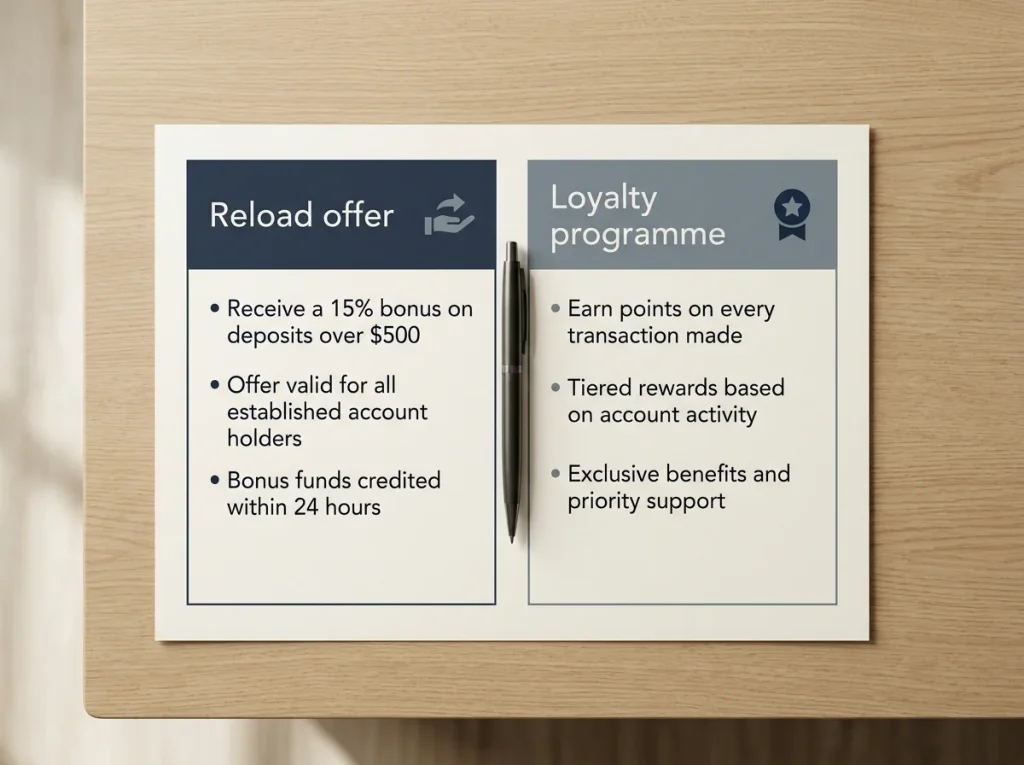
The two terms overlap in casino marketing but describe slightly different mechanics. A reload bonus is a deposit-triggered offer that fires when a player makes a qualifying deposit during a defined window – typically weekly or monthly. It works almost like a smaller version of the welcome match: deposit X, receive Y as a percentage match or fixed bonus value.
A loyalty bonus is a status-triggered offer that builds with cumulative activity rather than firing on individual deposits. Loyalty schemes typically track points, comp credits or tier status, and pay out periodically based on accumulated play. The reload-vs-loyalty boundary is fuzzy in practice because operators often run both side by side and structure them to reward the same underlying behaviour.
The relevant question for Payz users isn’t the label but the deposit-method eligibility. Reload offers are more often e-wallet eligible than welcome offers because the operator already has a verified Payz funding relationship by the time the reload triggers. The deposit-method exclusion that defeats welcome bonuses tends not to apply to reloads at the same operator. Loyalty schemes are almost universally method-agnostic because they track activity rather than funding source.
Payz eligibility on reloads
Most UK operators that exclude e-wallets from welcome offers nonetheless allow them on subsequent reload bonuses. The asymmetry sounds inconsistent until you understand the underlying risk reasoning. Welcome bonus exclusion of e-wallets is largely about preventing new-account bonus abuse. By the time a player is eligible for a reload offer – usually after a meaningful deposit and play history – the abuse risk has been screened out by ordinary account aging.
There are exceptions. A small number of operators apply the e-wallet exclusion to all promotional offers, welcome and reload alike. Some apply it selectively, allowing Payz on reload percentage matches but excluding it from cashback or insurance-type offers. The cleanest way to know which operator does what is to read the terms of each specific offer rather than relying on the operator’s general bonus policy.
Where Payz is allowed on reloads, the rollover terms tend to be lighter than welcome equivalents. Wagering multipliers of 20-30x are common, against the 35-50x typical for welcome offers. Maximum-stake caps during wagering are sometimes more generous. The result is that reload bonuses often offer better expected value per pound deposited than the headline welcome offer the same player chased at registration.
The fundamental constraint on reload value remains the same: the operator’s overall bonus budget. Reload offers tend to cycle weekly or monthly, with each iteration capped at a relatively modest absolute value – £20-£100 in matched bonus, rather than the £200-£500 sometimes seen on welcome offers.

Typical percentages and caps in the UK market
The UK online casino market generated £1.42bn in gross gaming yield during the second quarter of the 2025-26 financial year, which shapes the bonus budgets available across the operator base. Within that envelope, reload offer pricing follows recognisable patterns.
The most common UK reload structure is a percentage match on deposits during a defined window – Monday-Friday, Saturday-Sunday, or first deposit of each calendar week. Typical percentages run 25%-75%, with 50% being the most common round figure. Caps on bonus value tend to be £25-£100, occasionally £200 at larger operators.
Loyalty schemes pay out at lower percentages on volume but accumulate across all play rather than just qualifying deposits. A typical scheme returns 0.1%-0.5% of stakes as comp points or cashback, with redemption mechanics that vary widely. Some loyalty tiers compound – higher tiers earn higher percentages – and reaching the higher tiers requires sustained play over months.
The aggregate effect of stacking reload offers on top of a loyalty programme is often more valuable than the headline welcome offer over a six-month horizon. A player making £100 weekly deposits at an operator with a 50%-up-to-£25 weekly reload is collecting potentially £1,300 of bonus value across a year, compared to a one-time welcome offer of perhaps £200. The reload structure rewards consistent activity in a way the welcome match doesn’t.
Cumulative FX cost on frequent reloads
The FX dimension matters for reload-active Payz users in a way it doesn’t for one-off welcome claimants. If your Payz balance happens to sit in a non-GBP currency, every reload deposit triggers the tier FX rate – 2.99% on Classic and Silver, 1.49% on Gold, 1.25% on Platinum and VIP. Repeated weekly across a year, this is a meaningful cost.
Consider a player making £100 weekly Payz deposits at Classic tier from a EUR balance. Each deposit costs £2.99 in FX. Annualised that’s £155.48 in FX cost, before any wagering or losses on the deposits themselves. If the reload bonus is 50% up to £25 weekly, the bonus value is £1,300 a year – but the FX cost on funding those deposits is consuming over 10% of the gross bonus value.
At Gold tier the same scenario costs £77.48 annually in FX. At Platinum it’s £65 annually. The savings from tier upgrades, multiplied across high-frequency reload behaviour, can offset the documentation burden of the upgrade itself within a few months of activity.
The simpler approach for any UK player who plans to reload regularly is to keep the Payz balance in GBP and avoid the FX trigger entirely. Adding the GBP balance segment, funding it from a GBP source, and depositing from it at GBP casinos eliminates the FX layer from the equation regardless of tier. The FX cost only matters when there’s a currency mismatch, and for most UK reload activity there doesn’t need to be one.

Comparing reloads with cashback models
Cashback is a different bonus model that often runs alongside reload offers and is worth comparing on its own terms. Where reload offers reward deposit activity with bonus funds that have wagering requirements, cashback returns a percentage of losses with little or no wagering attached. The economics differ.
For a player whose typical session results in a net loss, cashback is more reliably valuable than a reload offer. A 10% cashback on weekly losses, with no wagering, returns 10p per pound lost as withdrawable cash. A 50% reload bonus, with 30x wagering, returns 50p of bonus per pound deposited but requires £15 of wagering to convert to withdrawable cash, by which time the bonus value has typically been reduced by losses on the wagering itself.
The crossover point – where reload economics beat cashback economics – depends on the player’s actual win rate and on whether the casino bonus terms allow conservative play during wagering. For most players at most operators, cashback is the more honest deal even though it has lower headline percentages. The welcome offer logic – and what’s actually available to Payz users at sign-up – is covered in the breakdown of UK welcome bonus availability for Payz deposits, which sits next to this piece in the bonus picture.

Do reload bonuses count Payz deposits towards monthly loyalty tier progress at the casino?
Yes at almost every UK operator. Loyalty schemes are funding-method agnostic and count cumulative deposits across all rails, including Payz. The bonus exclusion that sometimes applies to welcome offers does not apply to loyalty progression.
Is the FX cost on weekly reloads ever larger than the reload bonus itself?
For small reload deposits funded from non-GBP balances at Classic tier, the FX cost can absorb a meaningful share of the bonus value but rarely exceeds it. A £50 deposit at 2.99% FX costs £1.49 – a 50% reload of £25 still nets positive after that. The numbers compress for very small deposits or unusually tight reload terms.
Are reload bonuses transferable if I switch from Payz to another funding method?
The bonus is earned on the deposit, not the funding method. Once credited, the bonus and any winnings from it sit in your casino balance and can be withdrawn to any verified withdrawal method, including alternatives to Payz. The funding-method-match clause that sometimes applies to welcome offers usually does not extend to reload bonuses.
ecoPayz Casino Articles: UK Market Trends and Payment Data
Our top casino picks for the UK
- BeOnBetBonus: 100% up to €500 + 100 FS · Payout speed: 1-3 business days
- WinBeastBonus: €5000 + 500 FS + €650 Freebet · Payout speed: 1-3 business days
- NightWinBonus: £900 + 400 free spins · Payout speed: 1-3 business days
- JetsetspinsBonus: 200% Bonus + 100 Free Spins + Free Royal Wheel · Payout speed: 1-3 business days
- DieselwinBonus: Welcome Pack 250% up to £4000 + 200 FS · Payout speed: 1-3 business days
- EvoSpinBonus: 125% up to €2500 + 125 Free Spins · Payout speed: 1-3 business days
- SpinFormulaBonus: 550% Up To £15,000 + 550 FS · Payout speed: 1-3 business days
- Revery PlayBonus: 100% up to€1,000+ 100 FS · Payout speed: 1-3 business days
Written by the editors at Ecopayz Casino UK.